
Vampire Romance Books: Dark, Spicy, Gothic Reading Guide
The right vampire romance book depends on what kind of danger you want woven into the love story: gothic longing, teeth and obsession, first-love restraint, adult tension, immortal politics, or serial cliffhangers.
If you searched for vampire romance books, you likely already know the appeal: danger, restraint, hunger, and forbidden desire. What you need next is a sharper way to choose the kind of story you actually want.
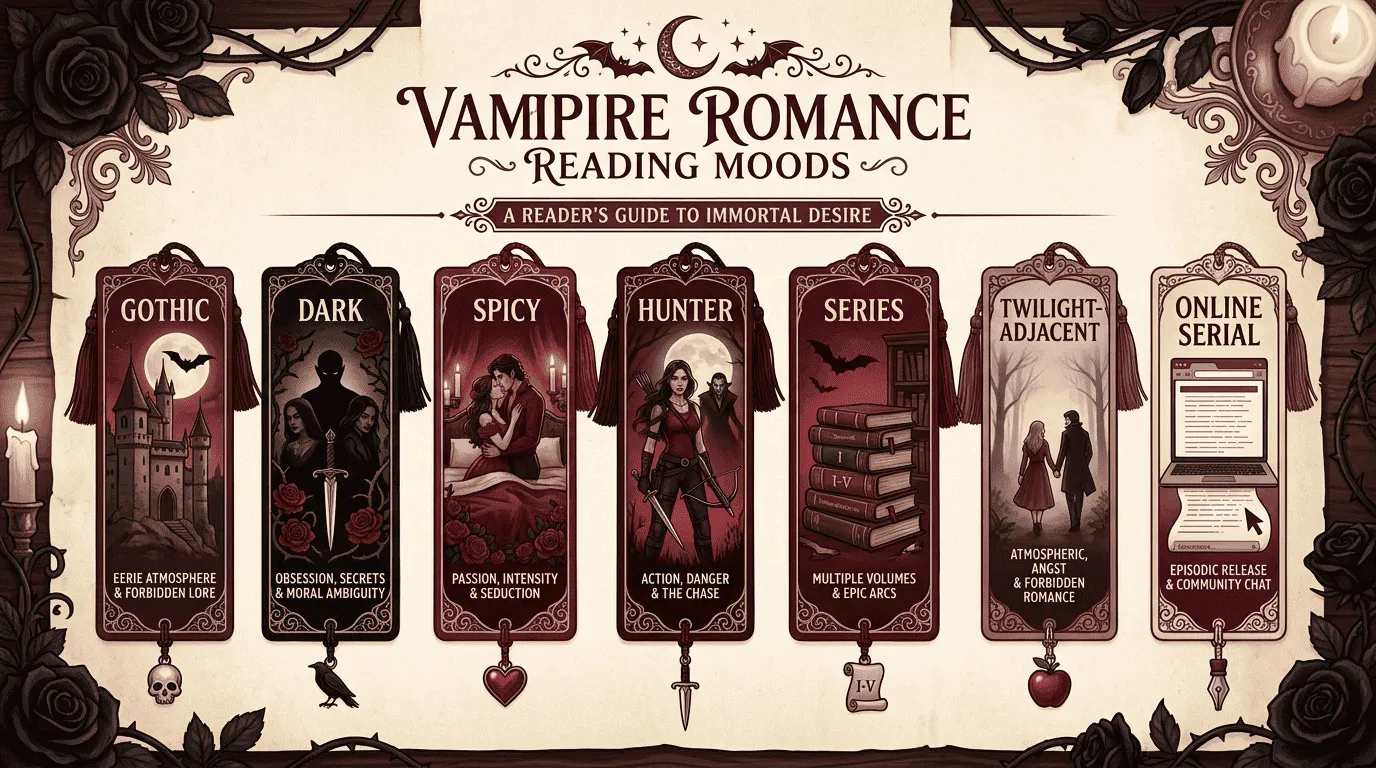
A smarter way to browse vampire romance books is not to start with a universal top-ten list. Start with the pressure you want: gothic atmosphere, dark moral risk, spicy adult tension, vampire hunter conflict, series lore, Twilight-adjacent restraint, or online serial momentum.
This guide gives you reading lanes, browsing signals, skip-if warnings, and search phrases so you can sort recommendation lists, reader reviews, bookstore pages, and online-story platforms with less guesswork.
🔎 Quick Picker: Which Vampire Romance Should You Read?
If you already know the feeling you want, use this as a shortcut. The deeper sections below explain how to judge book descriptions, reader reviews, and story tags.
- Gothic and atmospheric: Start with haunted settings, slow-burn suspicion, and romance that feels half invitation, half warning.
- Dark and dangerous: Start with moral risk, obsession, enemies-to-lovers pressure, and darker content you may want to check before reading.
- Spicy adult vampire romance: Start with adult paranormal romance where heat, power, and vampire rules shape the plot.
- Vampire hunter romance: Start with divided loyalties, betrayal pressure, and attraction that threatens both identities.
- Series-driven paranormal romance: Start with clans, courts, side couples, recurring rules, and a world you want to revisit.
- Twilight-adjacent tension: Start with first-love danger, secret identity, small-town closeness, and desire held back by restraint.
- Online vampire romance stories: Start with tags, first chapters, cliffhangers, niche tropes, and serial escalation.
🩸 What Makes Vampire Romance So Addictive?
Vampire romance works because desire is never only desire. It comes wrapped in hunger, age, secrecy, restraint, and the central question of the genre: what happens when the person who wants you could also ruin you?
The strongest vampire love interests carry two traits at once. They are dangerous enough to matter and controlled enough to be interesting. If the vampire is only cruel, the romance collapses into threat. If the vampire is only safe, the genre loses its bite.
That is why vampire romance feels different from broader paranormal romance. Werewolf stories often turn on pack, instinct, belonging, and fate; vampire romance more often turns on time, temptation, loneliness, secrecy, and moral choice. The vampire has usually lived too long, taken too much, hidden too often, or loved too rarely. Romance gives that character a reason to break pattern.
Readers who bounce off generic vampire romance novels often do not dislike vampires. They dislike stories where the vampire rules are decorative. A weak vampire romance uses fangs as costume; a stronger one lets hunger shape what the couple can say, hide, refuse, or risk. That is why the first choice is not one title versus another. It is the kind of pressure you want the story to hold.
🧛 Popular Vampire Romance Tropes Readers Look For
Trope labels help only when they point to a real relationship problem. The better question is what each trope does to the couple: what it forbids, exposes, delays, or makes dangerous.
Human x vampire forbidden love
This is the classic setup because the barrier is built into the characters' bodies. One person is mortal, vulnerable, and bound to ordinary time. The other lives by different rules. Choose this if you want the relationship to feel impossible before the plot adds any extra villain.
Vampire hunter x vampire
This trope works when attraction forces both characters to question the story they have been telling themselves. The hunter has to ask whether every monster is the same. The vampire has to decide whether being understood is worth becoming exposed. Choose this if you want every romantic step to feel like a betrayal of someone's training, family, order, or oath.
Enemies to lovers under supernatural rules
Enemies-to-lovers hits differently when the characters are bound by blood law, clan violence, hunter oaths, or old supernatural debt. Choose this if every step toward tenderness should create a practical problem, not just a witty argument.
Ancient immortal x modern human
The appeal is not only age-gap drama. It is the pressure of time. The immortal may have watched empires, wars, lovers, and betrayals fade into memory, while the human still believes one choice can remake a life. The romance becomes a clash between old resignation and new urgency. Choose this lane if you want longing, melancholy, and the ache of a love story where one life feels brief and the other feels endless.
Reluctant monster with a moral code
Many vampire romance novels hinge on a love interest dangerous enough to fear but disciplined enough to trust. A moral code gives the reader something to test. The more pressure the story puts on that code, the more satisfying the restraint becomes. Skip this trope if you dislike slow restraint and want the danger to become action, court conflict, or open threat quickly.
Blood bond, mate bond, or supernatural connection
Bond tropes intensify romance quickly, but they work best when the bond creates a problem instead of replacing character choice. If two characters are destined without conflict, the story can go flat. If the bond exposes desire before either character is ready to admit it, the trope earns its drama. Choose this when you want forced closeness, psychic intimacy, or fate that still leaves room for refusal.
Protector vampire with dangerous instincts
This trope is not interesting because the vampire is protective in a generic way. It works when protection creates a new danger: the vampire saves the human from one threat while revealing how much control they could take if they stopped holding back. Choose it for controlled possessiveness and high-stakes rescue scenes; skip it if you dislike protection that slips into surveillance or control.
Vampire royalty, courts, and secret societies
This lane is for readers who want private desire to become publicly dangerous. Court rules, bloodlines, rival houses, trials, and old laws can turn a relationship into a political risk. Choose it if you like romance that threatens a throne, a clan treaty, or exile; skip it if you would rather stay close to two characters than learn the rules of a supernatural society.
Transformation and becoming a vampire
Transformation stories force the romance to answer a cruel question: does love still count as love if it changes the beloved forever? The best versions make the choice costly, not just glamorous. This trope works best when identity, consent, mortality, and the fear that forever may not feel like a gift all sit inside the romance.
Second chance across lifetimes or reincarnation
Immortality makes second chance romance sharper. One character may remember everything; the other may remember nothing, or only enough to feel haunted. Choose this if you want longing, guilt, old vows, and the ache of loving someone who is familiar but not the same.
🖤 How to Match Vampire Romance Books to Your Reading Mood
There is no single best vampire romance book for every reader. A reader looking for gothic ache may hate a fast paranormal romcom. A reader chasing spicy adult vampire romance may find a restrained YA-style relationship too quiet. Start with the mood, then choose the format, series length, or reading path that fits it.
The most common mismatch is choosing the wrong pressure. Someone asks for dark vampire romance books and receives a book that is only gloomy. Someone asks for spicy vampire romance books and receives a book that is adult in theme but low on heat. Someone asks for vampire romance books like Twilight and gets the exact plot furniture instead of the emotional recipe.
Dark and dangerous vampire romance: start with moral risk
Dark vampire romance is for readers who want desire to feel risky. The vampire may be morally compromised, the world may punish softness, and the love story may involve fear, obsession, revenge, old violence, or enemies trapped in a bargain they cannot easily escape. Dark does not simply mean the vampire is cruel. It means the relationship changes the moral weather around both characters.
- Start here when: You want danger, obsession, high stakes, and a romance that tests the characters' moral lines.
- Best matched with: Morally gray vampires, enemies-to-lovers pressure, revenge plots, hunter conflict, dangerous bargains, or old debts that leave both characters with limited choices.
- Skip if: You want soft comfort, clear consent cues from page one, or a love interest whose danger is mostly aesthetic.
- Search phrase: dark vampire romance books, vampire enemies to lovers romance, morally gray vampire romance.
For your next read, open the blurb and check whether the central danger changes what the couple can safely do together. If the description only says "dark" but gives you no moral line, bargain, threat, or consequence, keep browsing. Dark romance works best when the risk changes the relationship, not just the mood.
Spicy adult vampire romance: check the heat signal before you commit
Spicy vampire romance is strongest when heat grows from the vampire premise. Hunger, restraint, secrecy, heightened senses, blood rules, and supernatural vulnerability should shape the intimacy. If the same scenes could move into a non-paranormal novel without changing much, keep browsing for a book where the vampire rules do more of the romantic work.
- Start here when: You want attraction, intimacy, and power tension close to the center of the plot.
- Best matched with: Clear heat-level signals, adult paranormal romance labels, fated bonds, sensual gothic tone, high-chemistry banter, or explicit content notes.
- Common mismatch: Adult does not always mean spicy, and spicy does not always mean dark. Mature themes, older characters, and explicit heat are separate signals.
- Search phrase: spicy vampire romance books, adult vampire romance books, steamy vampire paranormal romance.
A useful test before you buy or download: ask whether the blurb sells desire as a plot problem or only as a tone. If the vampire rules do not affect secrecy, touch, hunger, consent, or control, the book may be spicy without being especially vampire-specific.
Gothic vampire romance: choose atmosphere over speed
Gothic vampire romance is less about speed than atmosphere. You read it for the house that feels alive, the family portrait that should not be watching, the old letter, the closed wing, the village rumor, and the lover who knows too much about death.
Start here when you want dread with longing, slow suspicion, haunted settings, and romance that feels doomed before it feels safe. Look for manors, castles, old families, isolation, inheritance plots, curses, missing histories, and prose that lingers on mood.
Skip this lane if you want quick chemistry, modern banter, fast plot reveals, or a vampire world built around action more than atmosphere. When browsing, terms like gothic vampire romance books, gothic paranormal romance vampires, and atmospheric vampire romance usually get you closer to this mood.
This lane often works better as a standalone or slower series opener than as a rapid-fire action romance. Choose it when you want the setting to keep asking whether the romance is rescue, trap, inheritance, or curse.
Vampire romance series: decide what kind of binge you want
A vampire romance series is the better choice when you want more than one couple or one central mystery. Series can build clans, hunter organizations, royal houses, rival species, ancient wars, and recurring side characters.
- Start here when: You want lore, recurring characters, side couples, politics, and the comfort of returning to familiar rules.
- Best matched with: Book-one labels, shared-world descriptions, clan or court conflicts, multi-couple arcs, or one-couple multi-book structures.
- Common mismatch: Some series follow one couple across several books; others switch couples each book. Check this before committing.
- Search phrase: vampire romance series, best vampire romance series, paranormal vampire romance series.
If you want one relationship to deepen book by book, look for a one-couple series. If you prefer a new romance with each installment, look for shared-world paranormal romance. Both can be vampire romance series, but they satisfy different reading habits.
Vampire romantasy: look for courts, bargains, and bloodline stakes
If you already enjoy romance with court politics, trials, magic systems, and dangerous bargains, vampire romantasy is a natural fit. It adds bloodline power, immortal rulers, old houses, and laws written long before the heroine was born.
- Start here when: You want the romance to threaten a throne, a treaty, a clan hierarchy, or a supernatural contract.
- Best matched with: Vampire courts, royal bloodlines, magical trials, forced alliances, political marriages, exile, and bargains with consequences.
- Skip if: You prefer the romance to stay intimate and character-led rather than wrapped in worldbuilding and political stakes.
- Search phrase: vampire romantasy books, vampire court romance, vampire fantasy romance books.
Choose this lane when you want the couple's private choices to change public power. Avoid it if you tend to skim court rules, family trees, councils, trials, or magical contracts to get back to the relationship.
Twilight-adjacent vampire romance: separate the feeling from the furniture
Searches for vampire romance books like Twilight usually point to a feeling more than a plot checklist: first love, danger held back by restraint, a human entering a hidden supernatural world, and the fantasy of being chosen by someone powerful. Readers may want that shape again without repeating the same age category, love triangle, school setting, or exact character dynamic.
If you want restraint, look for slow-burn human-vampire secrecy, protective danger, and desire held back by a rule neither character can ignore. If you want mature stakes, move toward adult paranormal romance with older characters, harder consequences, and less school-centered pacing. For the hidden-world feeling, small-town, campus, or close-community supernatural secrets usually work best when ordinary life keeps brushing against immortal rules.
Useful search phrases include vampire romance books like Twilight, human vampire forbidden romance, and YA vampire romance for adults.
The trap is copying the furniture instead of the feeling. A book can have a school, a forest, and a protective vampire and still miss the real draw: danger held back long enough for restraint to become part of the romance.
📚 Vampire Romance Books vs. Vampire Romance Stories Online
Traditional vampire romance books and online vampire romance stories serve different reading habits. Books usually offer a polished arc, clearer packaging, more reader reviews and lists, and an easier way to follow a completed series. Online stories often offer faster entry, serial momentum, niche trope variation, and a stronger feeling of discovery.
Readers who live in online fiction spaces know the pleasure of a chapter that does not behave like a tidy paperback chapter. It may end on a confession, a door opening, a bite that should not have happened, or a message from the wrong immortal. That kind of serial pressure suits vampire romance.
Reader note: If you are trying online vampire romance stories, judge the first chapters by pressure, not only prose polish. A strong serial opening usually makes the relationship problem obvious quickly: the vampire wants something, the human is not safe, and the rules make the attraction inconvenient.
If that serial rhythm is what you want, try browsing original supernatural romance and adjacent fantasy stories in an online-story format; SeaBell can fit that kind of discovery path. Use it as a way to test first chapters and tags, not as a replacement for traditional book lists or one perfect all-time recommendation.
✅ How to Choose the Right Vampire Romance Novel
Before you start a vampire romance novel, check the blurb, reviews, and tags for six signals: danger, heat, consent and tone, format, POV, and whether the trope is doing real story work.
- Danger signal: Is the threat romantic, frightening, political, physical, magical, or all of those at once?
- Heat signal: Is the book adult because of explicit intimacy, older characters, darker consequences, or mature emotional themes?
- Consent and tone signal: Does the description suggest consensual adult heat, morally gray power dynamics, coercive danger, or content you may want to check first?
- Format signal: Are you choosing a standalone, one-couple series, shared-world series, or ongoing online serial?
- POV signal: Do you want a human viewpoint that preserves mystery, a vampire viewpoint that exposes hunger and guilt, or dual POV that lets both forms of fear breathe?
- Trope signal: Does the book use hunter conflict, blood bond, transformation, court law, second chance, protector instinct, or secret identity as a real engine?
If you DNF vampire romance often, your mismatch may not be the genre. You may be choosing the wrong pressure. A reader looking for lush gothic romance and a reader craving a spicy modern vampire series may use the same search term, but they are not asking for the same night.
✍️ Bonus: Want to Write Your Own Vampire Romance?
If this guide gave you your own premise idea, start with the same pressure you would look for as a reader. Some readers arrive looking for vampire romance books and leave thinking about the hunter who hesitates, the immortal who refuses to turn the person they love, or the vampire court that treats desire like treason.
Start with pressure instead of aesthetics. Fangs, moonlight, velvet, and blood-red rooms can set the mood, but they will not carry the plot unless the romance has a rule it keeps breaking.
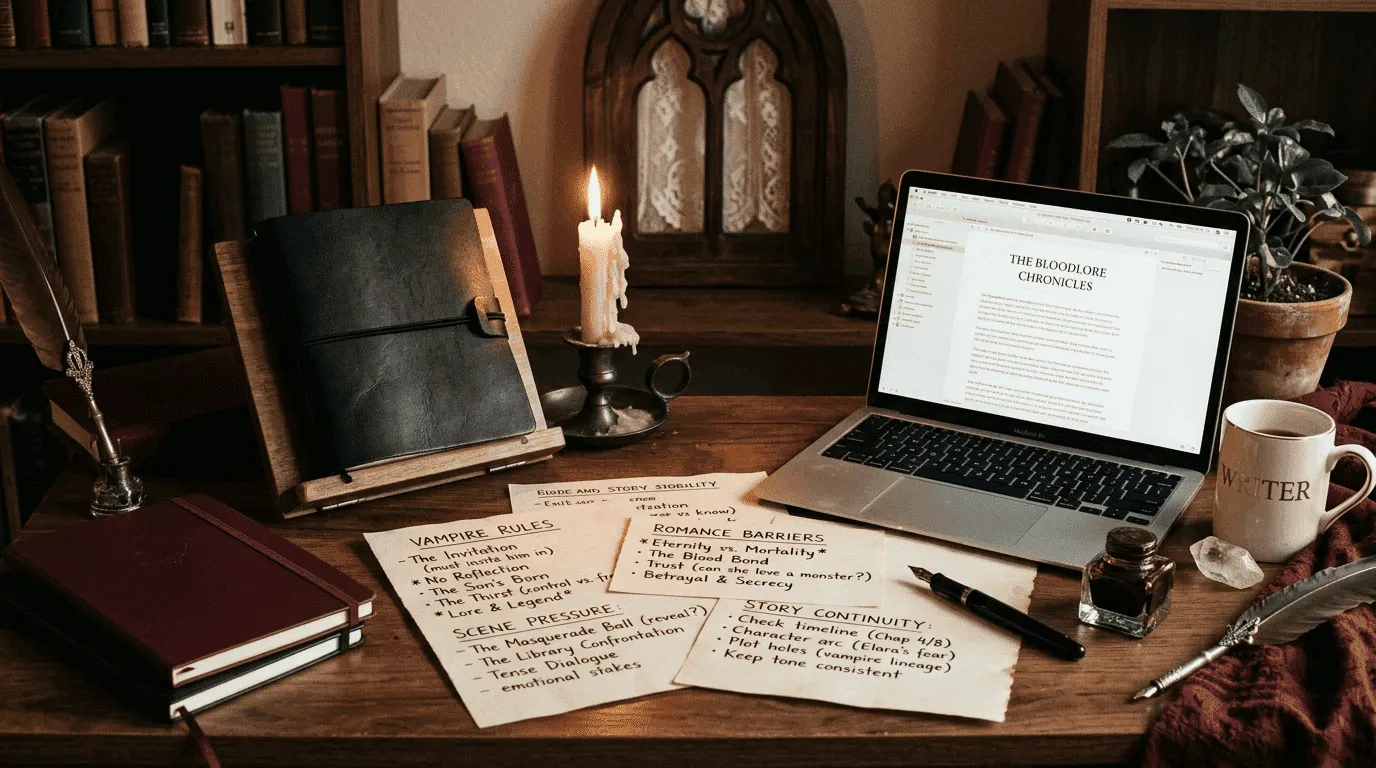
- Choose the core danger. Hunger, immortality, secrecy, power, transformation, or old guilt should sit at the center of the story.
- Choose the romance barrier. Species difference, hunter conflict, family law, court politics, a blood bond, an oath, or a past betrayal can keep the characters from easy happiness.
- Choose the restraint rule. Decide what the vampire wants but must not do. The rule matters because breaking it should cost something.
- Turn trope into scene pressure. "Vampire hunter x vampire" is a label. "She has to hide him from the order that raised her" is a scene engine.
A useful test: if your vampire could confess love without changing what they are allowed to do next, the romance barrier may be too soft. Give the relationship a rule that makes the next scene harder. If those rules start spreading across notes, a fiction workspace like SeaBell gives you one place to keep the core decisions close to the draft; a story bible is the natural place to hold those rules before drafting.
❓ FAQ About Vampire Romance Books
What are vampire romance books?
Vampire romance books are romance novels or stories where a vampire character and the supernatural rules around them directly shape the central relationship. The vampire element usually brings danger, secrecy, immortality, hunger, transformation, or forbidden love into the romance arc.
What is the difference between vampire romance and paranormal romance?
Paranormal romance is the broader category, covering vampires, werewolves, witches, ghosts, fae, demons, psychics, and other supernatural elements. Vampire romance is narrower: the vampire's rules, hunger, age, danger, or immortality must matter to the love story.
What are the best vampire romance books for adults?
The best adult vampire romance books are the ones that match your preferred intensity: gothic restraint, explicit heat, dark power dynamics, long-series lore, or mature emotional stakes. Adult does not always mean spicy, so check the blurb and reader notes for heat level, tone, and content signals before choosing.
Should I start with a vampire romance series or a standalone?
Start with a standalone if you want closure and a lower commitment. Choose a vampire romance series if you want a recurring world, side couples, court politics, clan history, or one relationship with room to develop across several books.
What are common vampire romance tropes?
Common vampire romance tropes include human x vampire forbidden love, vampire hunter x vampire, reluctant monster, blood bond, vampire royalty, secret supernatural society, enemies to lovers, transformation, protector vampire, and second chance across lifetimes. Choose based on the relationship problem you want, not the trope label alone.
Are there vampire romance books like Twilight?
Yes, but "like Twilight" can mean several different reading promises: human-vampire first love, secret identity, protective restraint, small-town closeness, YA-adjacent pacing, or the feeling of desire held back by danger. Decide which part you want before searching, especially if you want the emotional tension in a more adult setup.
Where can I read vampire romance stories online?
You can read vampire romance stories online through fiction platforms, serial-story communities, and genre-focused reading apps, but the better filter is the opening itself. Browse tags, first chapters, and tone signals; a strong start should quickly show the danger, attraction, and rules.
Can I read vampire romance stories online for free?
Some vampire romance stories, samples, or opening chapters may be free online, but access varies by platform, publisher, region, and chapter rules. Check availability before assuming the full book, story, or serial is free to read.
How do I start writing a vampire romance novel?
Start with the romantic pressure, not vampire decoration. Decide what makes the vampire dangerous, what rule makes the love difficult, and what each character loses if they choose each other.
🌙 Final Takeaway: Choose the Feeling Before the Fang
Vampire romance books are not one shelf with one promise. The right pick depends on whether you want gothic dread, moral danger, adult heat, series lore, first-love restraint, hunter conflict, or serial cliffhangers.
Start with the lane that matches the pressure you want most. The right vampire romance is the one where the danger matches the desire you came to read.