

How to Write a Book Blurb That Hooks the Right Readers | SeaBell
You may have an entire novel in mind, but a blurb only needs enough of it to make the right reader curious. Identify five fields from the manuscript: the protagonist, disrupting force, immediate goal, main obstacle, and concrete stakes. Use them to choose which part of the reading experience to highlight, build a working spine, and draft reader-facing copy. Then revise in five passes: select the right details, verify the facts, clarify the conflict, tune the voice, and compress the copy for display. This guide is about fiction book blurbs, not query letters, full synopses, or general book marketing.
🧭 What Is a Book Blurb?
A book blurb, also called a book description, is short copy that presents a premise, specific conflict, stakes, and tone without revealing the ending. It helps a potential reader decide whether the story promises the kind of experience they want.
A blurb is not a shortened synopsis. It highlights the tension that makes readers want to find out what happens. A synopsis explains how the story resolves.
The table below shows how a book blurb differs from other forms of writing. This guide focuses on the book blurb listed first.
| Artifact | Audience | What it reveals | Main job |
|---|---|---|---|
| Book blurb or description | Potential reader | Premise, selected conflict, stakes, and tone; not the ending | Give the reader a clear reason to keep reading |
| Synopsis | Editor, literary agent, or collaborator | Full plot, major turns, and ending | Show how the story works as a whole |
| Endorsement blurb | Potential reader | Another person's opinion | Add outside credibility |
| Pitch | Editor, literary agent, producer, or collaborator | Core concept and market position | Earn further attention |
Blurb is also the name of a publishing platform, but that platform's bookmaking tools are outside this guide. Here, "blurb" refers to reader-facing fiction copy. Nonfiction descriptions often lead with a problem or reader benefit; this guide focuses on fiction, where character choice, conflict, consequence, and tone shape what the reader comes to expect.
🧩 Extract Five Fields from the Manuscript
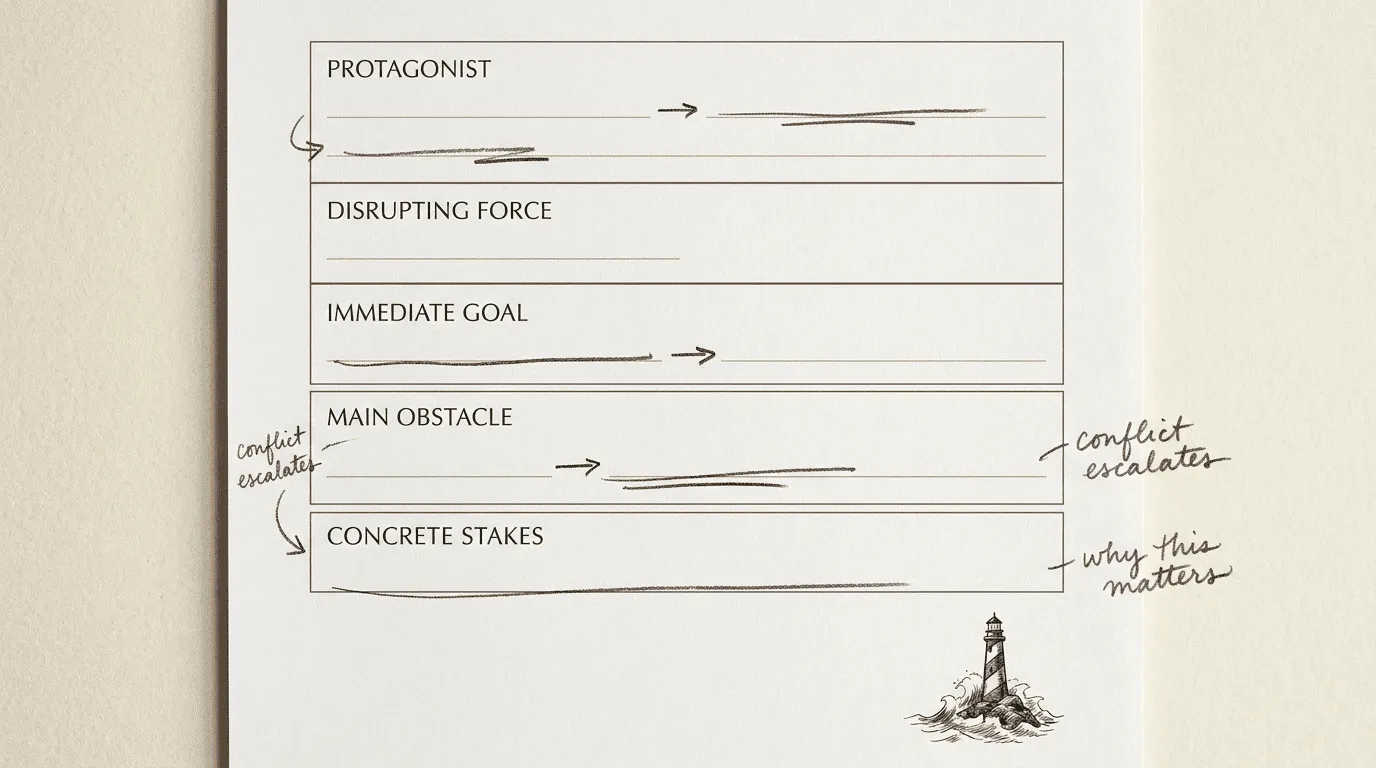
Start with the disrupting force: the event that breaks the story's starting situation. Take the protagonist and disrupting force directly from the manuscript, then frame the immediate goal, main obstacle, and concrete stakes around the thread readers will follow. Use this hypothetical story setup when filling out the table.
In a storm-battered coastal town, an apprentice lighthouse keeper discovers that someone entered the locked tower and used the lighthouse light to send a false signal that led to the wreck of a passenger ship. Only the tower's keyholders could have entered, and each has a reason to lie. Her father is missing, and the inquiry may blame him if she cannot identify who entered the tower.
Use the table to organize those five answers:
| Field | Question | Lighthouse example |
|---|---|---|
| Protagonist | Whose choices does the reader follow? | The apprentice lighthouse keeper |
| Disrupting force | What breaks the starting situation? | The false signal and the resulting wreck of a passenger ship |
| Immediate goal | What must this person accomplish now? | Identify who entered the locked tower |
| Main obstacle | What makes the goal difficult and specific? | Only the tower's keyholders could have entered, and each has a reason to lie |
| Concrete stakes | What changes if the protagonist fails? | The inquiry may blame her missing father if she cannot identify who entered the tower |
When filling out the table, make the goal more precise than the vague phrase "find the truth." The immediate action might be to identify who entered the tower, protect a witness, or stop an inquiry from assigning blame to the wrong person. The character motivation guide offers prompts when the protagonist's goal, fear, and pressure are still unclear. The blurb only needs the details that directly shape the protagonist's next action.
Keep the stakes in line with the story. A quiet family novel may turn on whether a character admits a betrayal or leaves home, not whether the world ends. Internal conflict matters when it is the story's core appeal, but "inner demons" is not a concrete dilemma. State what the person wants, what makes the choice costly, and what changes if they refuse.
Start with one answer per field rather than listing dozens of details. Add a second detail only when the first does not make the conflict clear.
🎯 Choose What the Blurb Should Promise
The five fields show what your manuscript contains. Now choose which reading experience the blurb should lead with. A mystery may highlight evidence, suspicion, and a specific question. A gothic novel may highlight a storm-battered setting, the locked tower, and uncertainty about whom to trust. Romantic suspense may highlight an investigation made harder by an established relationship, but only when that relationship is central in the manuscript.
Your choice shapes which true details the blurb emphasizes. Even an exciting line can misrepresent a quiet mystery as an action thriller or make an incidental romance sound central. If the promise you are considering requires details that are not in the manuscript, choose another angle.
Write the next sentence for yourself, not for the reader. It will stay behind the scenes and help you decide which details to carry into the next step.
Here is the sentence to write for yourself:
This is a [genre] story that promises [reading experience] as [protagonist] faces [specific pressure].
For the lighthouse example: This is a coastal mystery that promises a focused investigation as an apprentice keeper faces the pressure of identifying which keyholder entered a locked tower while the inquiry may blame her missing father.
🧵 Build a Working Spine Before You Draft
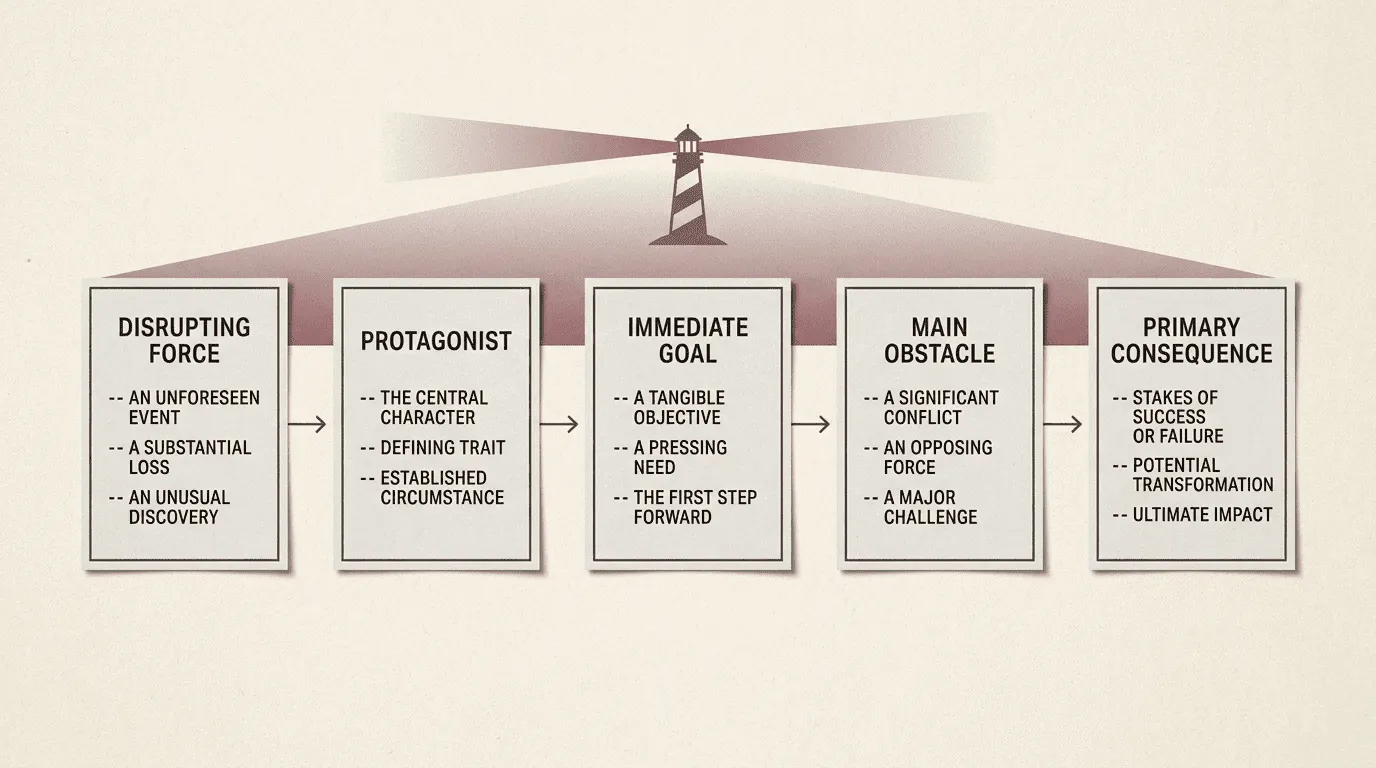
Think of a working spine as a private sentence linking the disrupting force, protagonist, immediate goal, main obstacle, and one primary consequence before you shape the language for readers.
Compress those fields into one sentence:
After [disrupting force], [protagonist] must [immediate goal] despite [main obstacle]. If they fail, [primary consequence].
For the lighthouse example:
After a false signal leads to the wreck of a passenger ship, an apprentice lighthouse keeper must identify which keyholder entered the locked tower even though every keyholder has a reason to lie. If she cannot, the inquiry may blame her missing father.
✂️ Decide What Stays Out
Use these filters while drafting and revising.
Keep a detail when it clarifies whose choices matter, sharpens the central pressure, signals the genre, or shows what is at stake if the protagonist fails.
In most cases, you can leave out:
- Secondary characters who do not change the protagonist's central choice.
- Proper nouns that need a paragraph of explanation.
- Worldbuilding history, factions, and rules that are not part of the obstacle.
- Childhood backstory that does not change the immediate stakes.
- A chain of events after the main escalation is clear.
- Midpoint and climax revelations.
- Praise words the story has not earned on the page.
- Comp titles that are inaccurate or used in place of a clear description.
A high word count is not the only sign of an overloaded blurb. Look at how often a reader has to pause and ask, "Who is this, and why does this fact matter now?" Remove any detail that leaves readers wondering who this is or why it matters unless it sharpens the central choice. Resist the urge to add another dramatic line to make up for it. When someone unfamiliar with your manuscript can sense the mood but cannot state the problem, you have given them atmosphere without a premise. If they can name the goal and stakes but still cannot connect the facts, the issue is a missing cause-and-effect link, not necessarily too much detail.
Many blurbs need only one or two named characters, but there is no hard cap. Add another name when the relationship or conflict makes it necessary and the role is immediately clear. Keep a piece of lore when it functions as an obstacle rather than decoration. Keep a quiet internal conflict when the choice itself is what the book asks the reader to follow.
Stakes follow the same rule: if the actual consequence is a damaged reputation, a broken family arrangement, or the loss of a specific opportunity, write that consequence. Calling it the end of the world inflates the stakes and tells the wrong reader what sort of book they are opening.
✍️ Turn the Spine Into Reader-Facing Copy
A strong blurb usually has four jobs. You can change their order by genre:
- Hook: Open with a story-specific pressure, contradiction, or event.
- Setup: Establish the protagonist, immediate situation, and goal.
- Escalation: Show the obstacle and what failure costs.
- Closing pull: Leave the reader with an unresolved choice, risk, or question without giving away the ending.
Genre also affects how much space each job receives. A literary novel may use a quieter opening and a more reflective closing. A fast mystery may put the disruption in its first line.
Rhetorical questions are optional. A generic one, such as "Will she uncover the truth?", only asks whether the protagonist will succeed. It adds no dilemma, cost, or uncertainty. A specific question can work: "Can she identify the entrant when every keyholder has a reason to lie and the inquiry may blame her missing father?" Use one only when it makes the actual pressure sharper.
Instead of a generic opening like "A thrilling journey begins," start with a specific event or pressure from the story. Let the closing line focus on the unresolved choice, risk, or question the manuscript actually delivers. A strong hook comes from visible cause and consequence, not just dramatic phrasing.
📖 Book Blurb Example: From Weak Copy to Focused Versions
Use the working spine and the four jobs above to start drafting. The weak version below uses the same raw material but loses force through poor selection and wording:
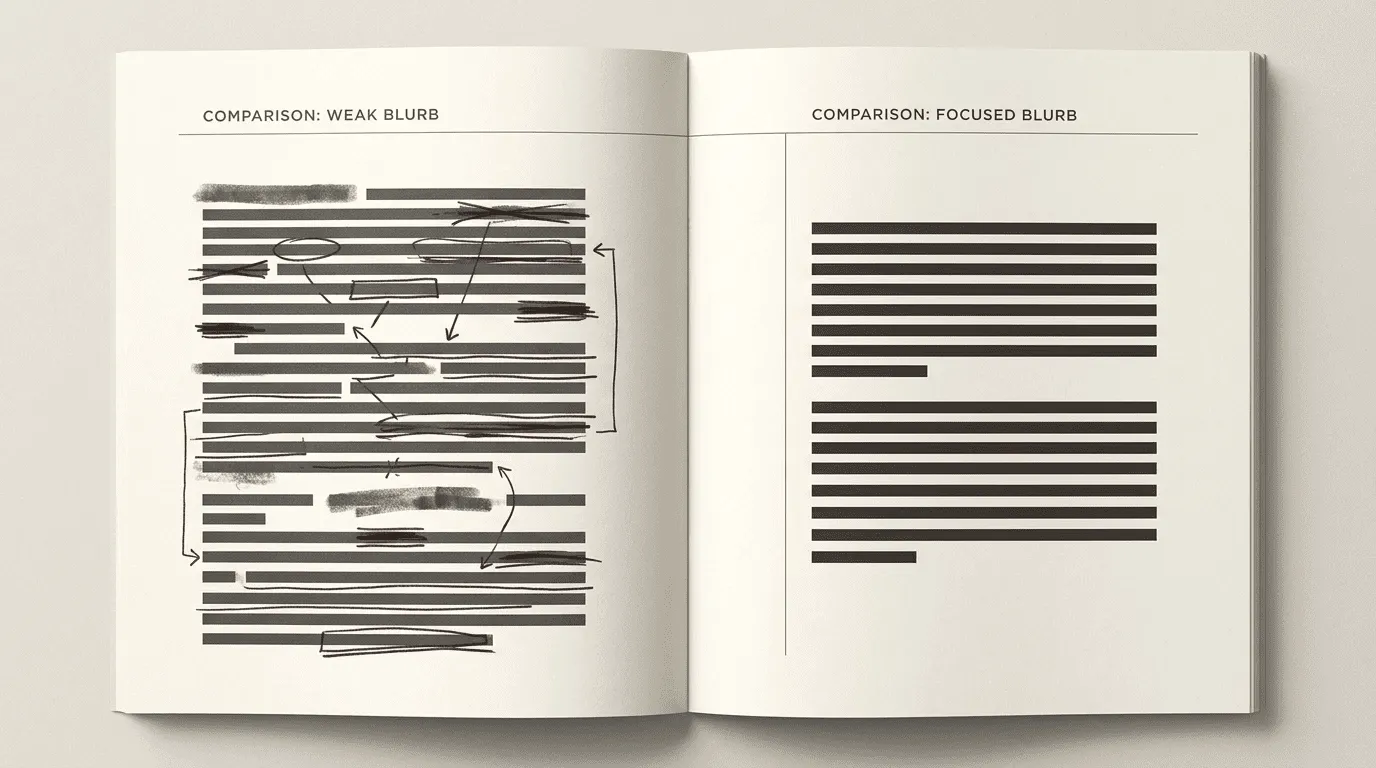
After a false signal leads to the wreck of a passenger ship, a brave apprentice keeper must uncover the truth about the locked tower. Her missing father may be blamed, and every keyholder has a reason to lie. As the mystery deepens, she must solve the case, clear her father's name, and expose the guilty party before it is too late. Can she find the truth before the inquiry makes the wrong choice?
Why this version loses force:
- Vague verbs:
"uncover the truth,""solve the case,"and"find the truth"describe an outcome without showing the immediate action. - Repeated stakes: Blame, clearing the father's name, and the inquiry's wrong choice repeat one pressure instead of moving the copy forward.
- Generic hype:
"brave,""the mystery deepens,"and"before it is too late"tell the reader how to feel instead of showing the problem. - Unsupported certainty:
"the guilty party"turns an unresolved suspicion into a confirmed fact.
A focused version might read:
Someone enters the locked tower and uses the lighthouse light to send a false signal. The signal leads to the wreck of a passenger ship. Only the tower's keyholders could have entered, and each has a reason to lie. An apprentice keeper must identify the entrant. If she cannot, the inquiry may blame her missing father.
The focused version also leaves the entrant unidentified, removing the unsupported certainty of "the guilty party." Phrases like "solve the case" use verbs that are too broad to show what the protagonist actually has to do. The phrase "She must identify the entrant; if she cannot, the inquiry may blame her father" preserves the pressure more precisely.
For a catalog or card field, compress it to one sentence: A false lighthouse signal leads to the wreck of a passenger ship; an apprentice keeper must identify which keyholder entered the locked tower, or the inquiry may blame her missing father. This drops the keyholders' reasons to lie and shortens the description of how the signal was sent.
🎭 Match the Genre Without Changing the Truth
The Mystery and Gothic versions use only the details established above. The Romantic Suspense version shifts the central pressure to a romantic relationship and requires two additional manuscript facts.
Mystery
Only the tower's keyholders could have entered, and each has a reason to lie. The entrant uses the lighthouse light to send a false signal that leads to the wreck of a passenger ship. An apprentice keeper must identify that person. Without an answer, the inquiry may blame her missing father.
Gothic
In a storm-battered coastal town, someone enters a locked lighthouse tower and uses the lighthouse light to send a false signal that leads to the wreck of a passenger ship. The entrant must be one of the tower's keyholders, but each has a reason to lie. An apprentice keeper must decide whom to trust as she tries to identify the entrant. The inquiry may blame her missing father if she cannot.
Romantic Suspense
Use this version only if the manuscript establishes two additional facts: the apprentice keeper has a central romantic relationship with a keyholder, and the evidence repeatedly points to that person during the inquiry.
The evidence repeatedly points to the keyholder the apprentice keeper loves. She must determine whether that person entered the locked tower and sent the false signal that led to the wreck of a passenger ship. If she cannot identify the entrant, the inquiry may blame her missing father.
📏 How Long Should a Book Blurb Be?
A draft of 150-200 words can be a useful starting point for a fiction blurb, but it is not a hard rule. A focused premise may need fewer words; a conflict with several moving parts may need more room.
Write shorter versions only when the destination requires them:
- Draft a polished one-line description for catalog fields or cards with tight limits.
- Prepare a one- or two-sentence version for a retailer preview or another collapsed excerpt.
The first sentence should work on its own; it is often the only text visible before a reader clicks to expand. There is no single ideal length for every platform, so check the actual destination and edit for paragraph shape as well as word count. A 160-word block of unbroken text can be harder to read than a slightly longer version divided into short paragraphs.
Draft enough copy to make the central conflict clear. When a destination requires less space, remove lower-priority details before cutting the central conflict or stakes.
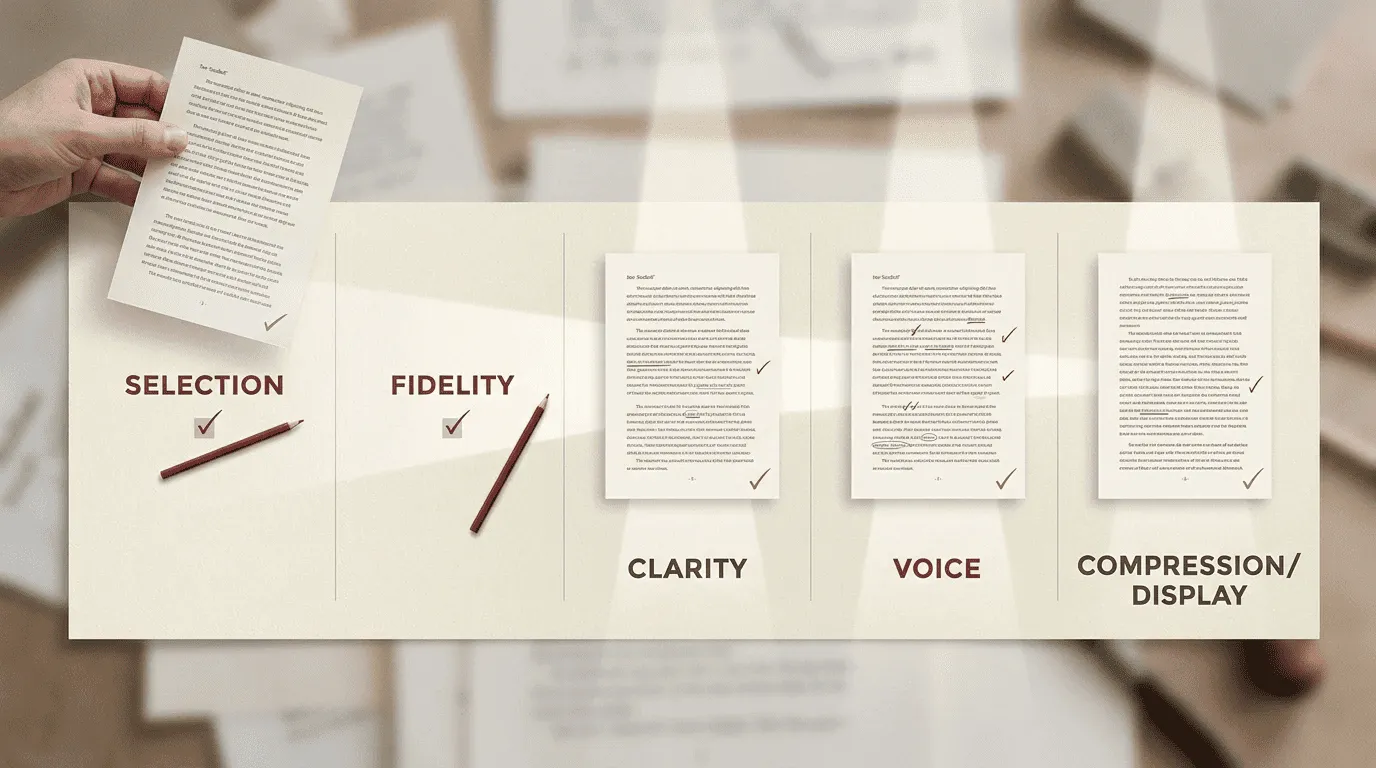
🔍 Revise the Blurb in Five Separate Passes
Handle the passes one at a time so each check stays focused.
Pass 1: Selection
Circle every name, proper noun, setting term, and plot detail. Ask whether it sharpens the genre promise, central conflict, or consequence. In the lighthouse example, the wreck, locked tower, missing father, and keyholders earn space because they create the pressure the protagonist must handle. Do not give an extra proper noun space unless it helps the reader follow the conflict.
Pass 2: Fidelity
Compare every claim with the manuscript. Is the father missing, confirmed dead, or simply away for a known reason? Is it established that someone sent the false signal, or is that still an open suspicion? Does the book contain a romance, a conspiracy, or a supernatural threat? Remove any line that sounds persuasive only because it adds facts the story does not support. For example, "The keeper races to stop a conspiracy" changes the scale of a story that contains only a local inquiry and one false signal.
Pass 3: Clarity
Show the blurb to someone who has not read your book. Ask them to name the protagonist, immediate goal, obstacle, and consequence. If they can sense the mood but cannot state the problem, replace atmosphere with a concrete action or pressure. If the goal and stakes are clear but the facts do not connect, rewrite the cause-and-effect link or add only the necessary established detail. Any lore that requires a glossary in the first paragraph should be cut or simplified.
Pass 4: Voice
Read the copy beside several successful blurbs in the same genre to notice conventions, not to copy phrases. Check syntax, detail selection, and emotional tone against the manuscript. A quiet mystery should not borrow the breathless language of a military thriller. Empty praise such as "unputdownable" or "a thrilling journey" cannot substitute for a story-specific reason to keep reading.
Pass 5: Compression and Display
Cut repeated information, explanatory clauses, stacked modifiers, and weak opening lines. Read the first sentence on its own; it may be all a reader sees. Then check where the copy will break into paragraphs and whether a shorter version still holds together. A shorter display version should preserve the same goal, pressure, and consequence even when it cannot carry every detail.
After the final pass, read the full copy once without marking it to catch problems that careful editing missed. If an extra character or piece of lore is hiding the protagonist's goal, remove it. If a cut breaks the cause-and-effect link, restore the one established detail that reconnects it.
🤖 Use AI to Test a Blurb, Not Invent the Book Promise
AI is most useful after the notes and working spine are in place. Give it a narrow assignment:
- Gather the working spine, intended genre and reading experience, spoiler limit, and any relevant manuscript notes.
- Ask for several alternatives that change one variable at a time, such as a clearer hook, a shorter opening, or a more restrained gothic rhythm.
- Reject invented characters, stakes, relationships, twists, credentials, reviews, and platform claims.
- Compare every sentence with the manuscript, including small changes to who knows what or what failure means, and discard any line the manuscript does not support.
An AI draft may read fluently and still turn a missing father into a murdered father, change a local inquiry into a national conspiracy, or elevate an incidental romance into a central promise. Fluent prose can still misstate the story.
For a long novel, keep the relevant facts in one place while checking an AI draft. A story-bible workspace can organize character goals, plot state, chapter context, and draft versions for reference. The SeaBell Story Bible template provides that structure for the story details you enter, keeping them near the drafting work while you compare blurb alternatives. For a single short blurb, you probably do not need that level of structure.
❓ FAQ
What does a complete, polished book blurb look like?
Here is a short example: After a false lighthouse signal leads to the wreck of a passenger ship, an apprentice keeper must identify the keyholder who entered the locked tower and sent the signal. If she fails, the inquiry may blame her missing father. It names the disrupting force, protagonist, immediate goal, and concrete stakes without revealing who actually entered the tower or how the story ends.
What is the difference between a blurb and a synopsis?
See the table in What Is a Book Blurb? for a side-by-side comparison. A blurb stops before the resolution, while a synopsis explains how the conflict is settled. The simplest test is the ending: if the copy tells the reader how the story resolves, you have written a synopsis rather than a blurb.
How many characters should a book blurb name?
There is no fixed number. One or two named characters are a useful starting point for many blurbs, but a relationship-driven premise may need more. Name each character only when the reader can understand the role immediately. If two protagonists share the premise, name both only when both goals are needed to understand the book; otherwise, let one viewpoint carry the opening. If a name needs a paragraph of explanation, leave it out.
✅ Final Check: Does the Blurb Earn Its Space?
These three questions focus on what the blurb promises: the goal, the supporting details, and the consequence. Voice and display were handled in Passes 4 and 5. Use them for a quick read before the copy leaves your desk:
- Is the protagonist's immediate goal clear and grounded in the manuscript?
- Does each selected detail sharpen the genre promise, conflict, or obstacle without adding an unsupported claim?
- Is the primary consequence true and proportionate, and does the copy leave the ending open?
Cut any line that fails these checks. If removing it breaks the causal chain, put back only what is needed to reconnect it. Whatever length a destination requires, the central promise stays the same.
Related Posts
Character Motivation for Writers: A 5-Part Framework | SeaBell
Learn how to build character motivation with a five-part framework for want, need, fear, wound, and pressure that creates difficult choices on the page.

Story Bible Template for Novel Writers: AI-Ready Guide
Use this story bible template to organize characters, world rules, timelines, plot threads, and AI drafting notes before your novel gets messy.