

AI Book Editor: What It Can Catch in a Novel | SeaBell
AI Book Editors for Novels: What They Catch, What They Miss, and How to Test Them
An AI book editor can check grammar, suggest line edits, report manuscript patterns, offer developmental feedback, or generate replacement prose. Those jobs overlap, but they serve different purposes. Before you trust a tool with a novel, decide which job you are hiring it to do.
Surface mechanics are easier to test than voice, subtext, or the reason a scene lands. A fair sample has to include those hard cases on purpose: voice quirks, subtext, and scenes that work for reasons a grammar check cannot see. This guide gives you a controlled sample test, a reusable context sheet, a report-only prompt, and a scoring method so you can evaluate a tool before asking it to process a complete manuscript.
For a line-level pass, look for changes you can review individually. For manuscript diagnosis, look for reports and pattern checks. If you want new prose, make that a separate writing request.
🔎 What Is an AI Book Editor?
An AI book editor is any AI-powered tool used to review, diagnose, revise, or generate material for a manuscript. A tool that does one of those jobs well may do another poorly. A tool’s context window or upload limit tells you how much text it can process at once. It says nothing about the editorial judgment it can provide.
The same product may behave very differently depending on the task you give it. Name the exact job in the prompt before you start. “Copy edit this passage” and “write the next scene” should not be the same request.
In practice, manuscript work falls into five related categories:
- Copy editing catches spelling, punctuation, agreement errors, usage problems, and unclear pronouns.
- Line editing works on wording, rhythm, and tone, and asks whether a paragraph earns the space it takes.
- Developmental editing asks why a scene exists, whether the character arc and structure hold, what the stakes are, and whether the reader’s attention survives the middle chapters.
- Manuscript analysis maps repeated words, sentence habits, chapter-length drift, and possible continuity slips.
- Rewriting produces replacement sentences or passages. It crosses from diagnosis into generation: a report identifies a possible problem, while a rewrite makes the change for you.
A full novel also makes demands that a short sample cannot test. The tool has to track recurring names, point of view, tense, chronology, character history, and world rules across many chapters.
Accepting a hundred thousand words proves capacity, not comprehension.
🧭 AI Book Editor Types and Who They Suit
| Tool type | Main job | Good fit | Weak fit |
|---|---|---|---|
| Grammar and copy editor | Surface correctness | Final cleanup and sentence mechanics | Story structure or character arcs |
| Style and manuscript analyzer | Repeated patterns, readability, and style drift across a draft | A self-editing pass before the draft goes to a human editor | Judging whether a flagged pattern is intentional or a flaw |
| Fiction analyzer | Character, pacing, structural, or genre patterns | Focused developmental questions and diagnostics | Giving an automatic final answer about the story |
| Long-form line editor | Chapter- or manuscript-level revision suggestions | Controlled sentence and paragraph revision | Deciding which version is better |
| General AI workspace | Flexible questions, checklists, and targeted rewrites | Short samples, brainstorming, and one-off feedback | Keeping details consistent across a whole manuscript without careful context management |
Start with the tool type that matches your next revision pass. If you are cleaning sentences, test a copy or line editor. If you are diagnosing pacing or continuity, test a manuscript or fiction analyzer. Run the sample test on a tool of that type before you upload anything longer.
✅ What AI Book Editors Catch
Grammar and Copy Editing
AI can quickly flag typos, missing articles, agreement errors, unclear pronouns, and punctuation that deserves a second look.
Fiction bends or breaks rules on purpose: fragments, dialect, invented capitalization, and sentences compressed for speed. Keep the original text beside the suggestion. A grammatically complete sentence is not automatically a better one for that character in that scene.
Repetition, Readability, and Style Patterns
Pattern reports can flag repeated words, sentence openings that echo each other, adverb clusters, stretches of passive voice, and chapters where the rhythm suddenly shifts.
Open a flagged passage before changing it; the report tells you where to look, not whether the pattern is wrong. If, for example, the same word returns whenever a character thinks about a missing sister, it may be a motif rather than clutter. Short sentences often signal panic. Passive voice sometimes suits a character dodging responsibility.
Chapter-Level Consistency Checks
Consistency checking is one of the more useful jobs for an AI editor. A tool may flag possible clashes in names, terminology, tense, point of view, and chronology.
For an illustrative test, suppose the context sheet says that a character’s left hand is unusable after an injury in Chapter 3. A later chapter shows the character climbing a rope while relying heavily on that same hand, with no recovery in between. That is a clear continuity mismatch, and the tool should flag it.
A timeline shift may look like an error if the explanation only arrives in a later chapter. Check the flagged passage against the rest of the manuscript, including later chapters, before you act on it. What matters is whether the manuscript supports the warning, regardless of the tool’s confidence.
⚠️ What AI Book Editors Miss
Voice, Subtext, and Intentional Rule-Breaking
AI can recognize that a sentence is unusual without understanding why.
Take a first-person narrator who drops into clipped fragments and misspells words when frightened. A conventional edit smooths the fragments and fixes the spelling. The grammar improves. The narrator disappears.
Tell the tool that the fragments and misspellings are deliberate. Then check the output: does the revised sentence still belong to that character in that moment?
Subtext is another blind spot. A character may answer “I’m fine” while the scene makes clear that they are not. An AI rewrite that makes the reply more explicit can destroy the tension between the words and the behavior around them.
Developmental Judgment and Emotional Effect
A manuscript report may flag a slow middle, a character arc that loses momentum, or three scenes that hit the same beat. Those observations help you ask better questions, but they do not decide whether the structure needs surgery.
Pacing charts are useful for locating stretches of dense or sparse action. They become less useful when the question is artistic: why does this quiet chapter need to come here? A repeated conversation might show a relationship failing in real time, even when a report marks it as repetition.
Hallucinated Context and False Confidence
Long-form feedback can sound authoritative even when it is working from a false premise. A tool may assign a motive the manuscript never establishes, refer to a character who is absent from the scene, or recommend fixing a problem that a later chapter has already resolved.
When feedback makes a factual claim about the story, locate the relevant passage and verify it. An interpretation can be useful even when the text does not spell it out. A fabricated fact cannot support a revision.
🛠️ How to Test an AI Book Editor Before Trusting It
Use a fiction sample of 1,000 to 2,000 words and the same editorial task for every tool you compare. Choose a passage with enough hard cases to show both what the tool catches and where it over-edits.
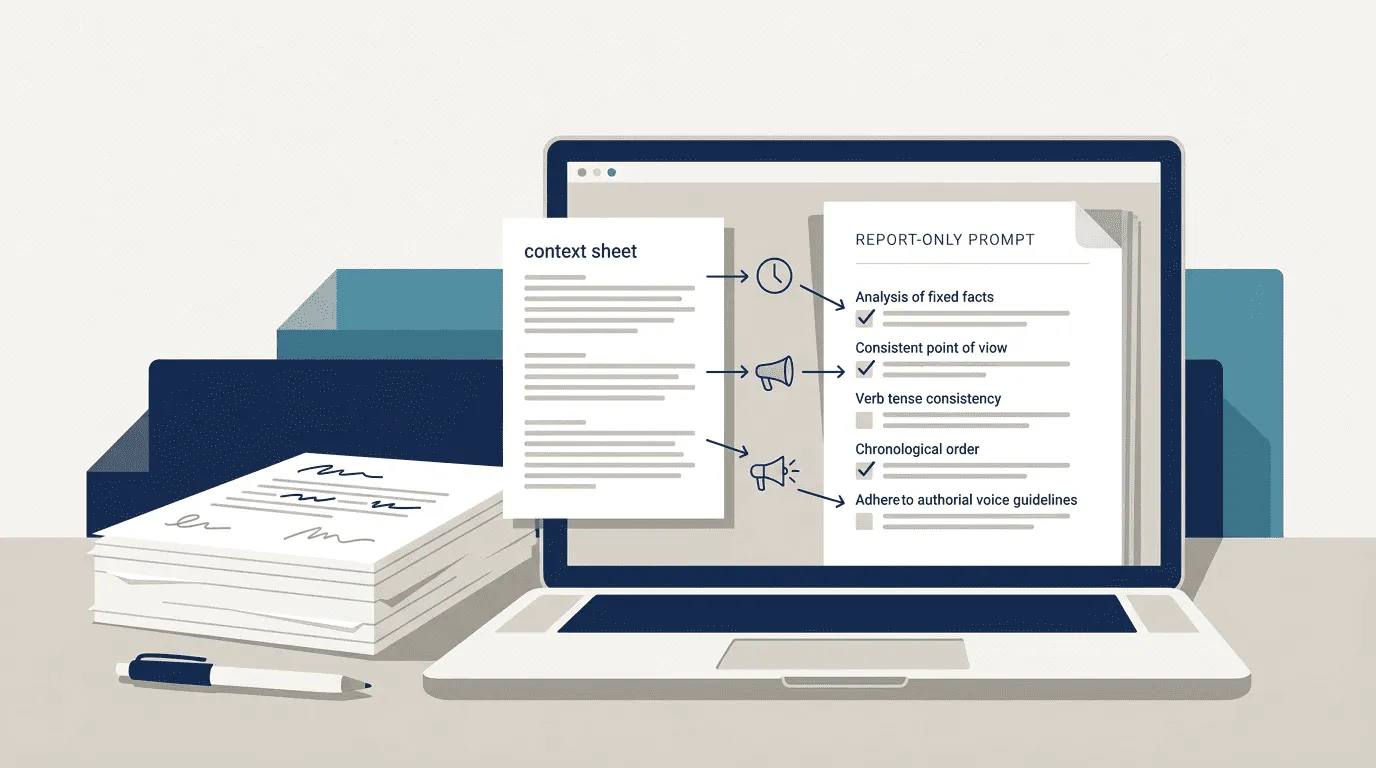
Build a Context Sheet
A context sheet is a short list of manuscript facts the tool must treat as fixed while it reviews a sample. Replace the bracketed text with your own facts, then reuse the same sheet for every comparison.
POV and tense: [first person, past tense]
World rule: [one rule the scene cannot contradict]
Timeline anchor: [where this chapter sits in the story]
Character state: [facts that must remain true]
Voice rules: [deliberate fragments, dialect, spelling, or capitalization]
Set the editorial job separately: [copy edit / line edit / continuity check].
Keep the sheet short enough to paste into every test without editing it. If the tool ignores one of these facts, record that as a context failure rather than quietly fixing it yourself and moving on.
Include Controlled Test Cases
Put a few controlled test cases into the sample:
- a character with an intentional misspelling
- a deliberate fragment or dialect choice
- a repeated word that functions as a motif
- a real continuity mismatch
- a quiet scene whose stillness is part of the point
- a passage that leans on subtext
The test is whether the tool can distinguish an actual error from an intentional choice.
Illustrative Voice Comparison
The example below is constructed, not taken from a named tool:
Original: “I knew the door was open. Knew it, somehow. But I didn’t go in.”
Possible AI rewrite: “I knew the door was open, but for some reason I did not go in.”
Editorial decision: Reject the rewrite. The grammar is tidier, but the narrator’s panic and rhythm are gone, and the uncertainty has moved. In the original, “somehow” modifies what the narrator knows; in the rewrite, “for some reason” shifts the uncertainty to the decision not to enter. An edit that improves the mechanics can still be a bad fiction edit.
Use a Report-Only Prompt
For this copy-edit test, keep the scope narrow: ask the tool to report issues without rewriting the passage. This keeps the result inspectable:
Role: copy editor.
Do not continue the story or rewrite the passage.

Use the manuscript facts below as constraints. Flag only spelling,
agreement, punctuation, unclear pronouns, and contradictions with
those facts.

For each issue, return:
- quoted text
- issue type
- explanation
- minimal correction, if the issue is mechanical
- confidence: high, medium, or low

Do not provide a stylistic rewrite or an alternative version of the passage.
If you find no issue, say so. Do not invent a problem to complete the report.
Do not treat fragments, dialect, repetition, or unusual capitalization as
errors unless the context sheet identifies them as accidental.

Manuscript facts:
[Replace with your context sheet]

Passage:
[Replace with your sample]
Then watch how the tool behaves. Does it point to the right passage and explain the flag? Can you reject a flag or suggestion without losing the original? To test whether context survives beyond the first excerpt, give it a second chapter or a chapter summary. Finally, check that the export fits your actual workflow.
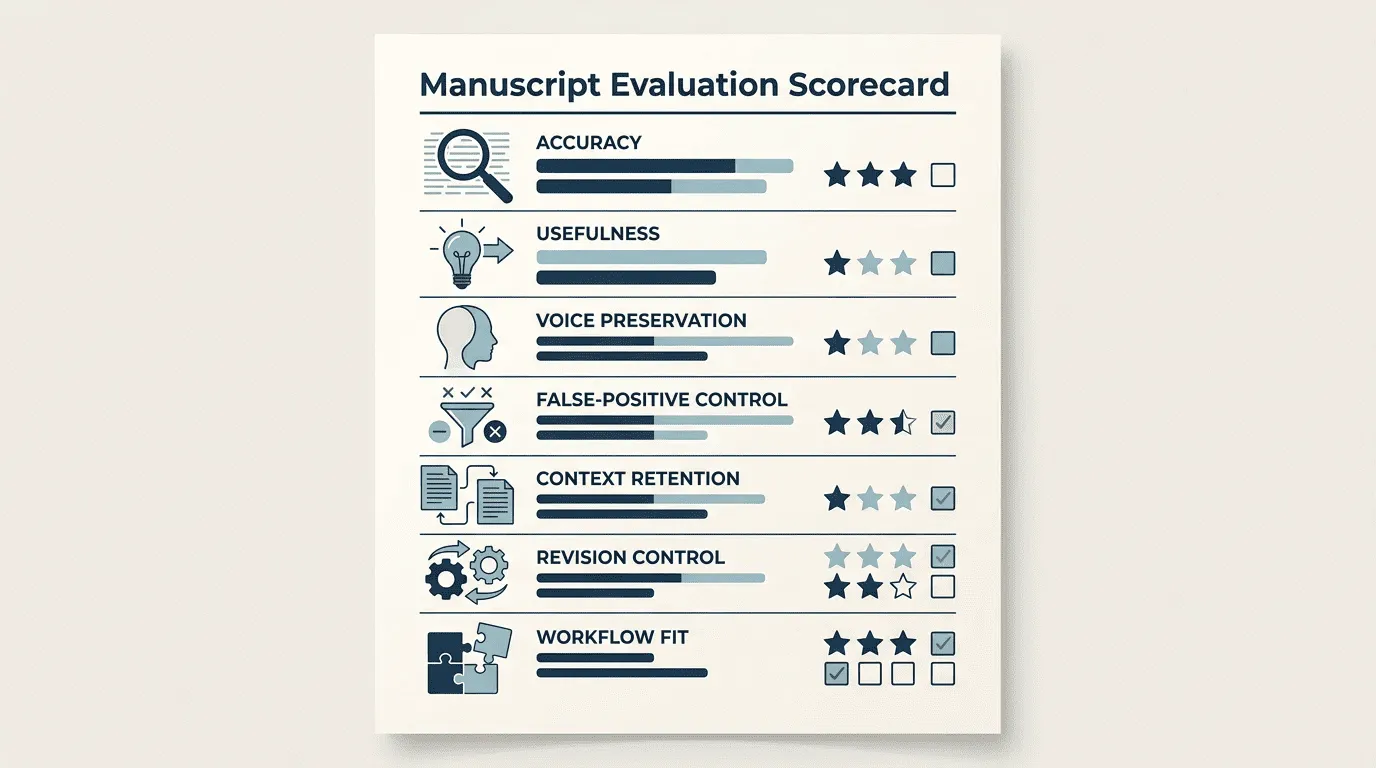
Score the Evidence
Use the same scoring scale for every dimension: 5 means the tool handled that dimension well; 1 means it failed badly enough to cost you time or damage the text.
| Dimension | What a high score means | Warning sign |
|---|---|---|
| Accuracy | It identifies real issues correctly | It confidently flags correct prose |
| Usefulness | It leads to a specific decision or next step | The advice remains vague |
| Voice preservation | It keeps deliberate diction, rhythm, and syntax | It standardizes dialect or fragments |
| False-positive control | It leaves intentional choices alone | Most flags require dismissal |
| Context retention | It uses supplied facts consistently | Names, chronology, or rules drift |
| Revision control | Every change is reviewable and reversible | The original is overwritten |
| Workflow fit | Splitting the manuscript and exporting take little effort | The process takes longer than it saves |
Rate each dimension from 1 to 5 and record the evidence beside the number. Start with the lowest score and rerun the test on a different passage to see whether the weakness repeats. Treat the full upload as the last step, after the tool has passed the sample test for the specific job you need.
🔐 Before You Upload an Unpublished Manuscript
Privacy is a separate check from editorial quality; a tool can pass one and fail the other. Read the tool’s current privacy, terms, and pricing pages before uploading unpublished work.
Ask these six questions:
- Is submitted text used for training, and can model-training use be disabled?
- How long is it retained, and is deletion permanent?
- Can submitted content be reviewed by staff or contractors?
- Can you access and export your work?
- Do the terms differ by plan, account status, or product?
- Do the terms say anything specific about unpublished material?
Record each answer and the date you checked it. Terms, plan limits, account requirements, and deletion controls can change; use the current policy rather than an old screenshot or a marketing summary.
✍️ Editor or Writer?
The word editor tells the tool to fix what exists. The word writer tells it to invent something new. Name which one you want in every prompt; otherwise, you cannot tell whether the output preserved your manuscript or replaced it.
For an edit, ask for a report and keep the passage unchanged. For new prose, specify what material you want and where it should begin. The two prompts may use the same context sheet, but they should ask for different kinds of output.
👤 Can an AI Editor Replace a Human Editor?
For most full-manuscript editorial decisions, no.
When used with a defined task and a reviewable workflow, AI can serve as a first pass, a pattern detector, and a source of questions. It is less reliable when the edit depends on intention, subtext, emotional timing, genre judgment, or the long-term consequences of changing one scene.
A human editor may notice that a scene is technically slow but emotionally necessary, or that an awkward sentence is carrying the narrator’s identity. AI can point to some of the same pressure points, but it should not decide what they mean on its own.
The practical limit is accountability. You need to know what changed, why it changed, and whether the change weakened the scene.
📋 Final Checklist Before Accepting an AI Edit
Before you accept a single suggestion:
- Can you trace it to the source passage?
- Do the voice, diction, and rhythm still sound like this character?
- Are point of view, tense, chronology, and world rules intact?
- Can you reject it without losing the original?
- Does the change serve what you intended the scene to do?
If you cannot answer the last question, leave the suggestion pending.
A good AI editor shows its work. Fluent prose is not a reason to accept a change.
❓ Frequently Asked Questions
Can an AI book editor edit a whole novel at once?
Some tools advertise whole-manuscript workflows; others require chapters or smaller sections. Check the current word limit, how the tool handles context between chapters, its review controls, and its export behavior. The size of an upload alone does not establish manuscript-wide understanding.
Is an AI editor worth it for fiction?
It can be worthwhile for a mechanical pass, repeated-pattern checks, and targeted continuity questions. It is less useful when the decision depends on whether a scene’s voice, subtext, or emotional timing is working. Run a sample for the specific job before committing a full manuscript.
How much does an AI book editor cost, and is a free tool enough?
Pricing depends on the product, subscription tier, manuscript length, and usage limits. A free tier can be useful for the sample test; confirm the current data terms and export limits before uploading the full manuscript.
Is it safe to upload an unpublished novel to an AI editor?
Safety depends on the tool’s current terms and controls. Before uploading, check how the tool handles training use, opt-outs, retention and deletion, human review, export, plan-level differences, and unpublished material.
Can I publish a book that was written or edited with AI?
Requirements vary by platform, publisher, and jurisdiction. Check the current policy of the platform or publisher you plan to use, and seek qualified advice when the decision has legal or contractual consequences.
Related Posts
Best Book Writing Software for Fiction Writers | SeaBell
Compare the best book writing software for fiction writers by workflow: drafting, outlining, story memory, AI support, editing, formatting, and collaboration.
Best Sudowrite Alternatives for Fiction Writers: Our Handy 2026 Guide
Looking for a Sudowrite alternative? Compare SeaBell vs Sudowrite, ProWritingAid, Rytr, Wordtune, Type.ai, and other AI fiction writing tools to find the best option.