
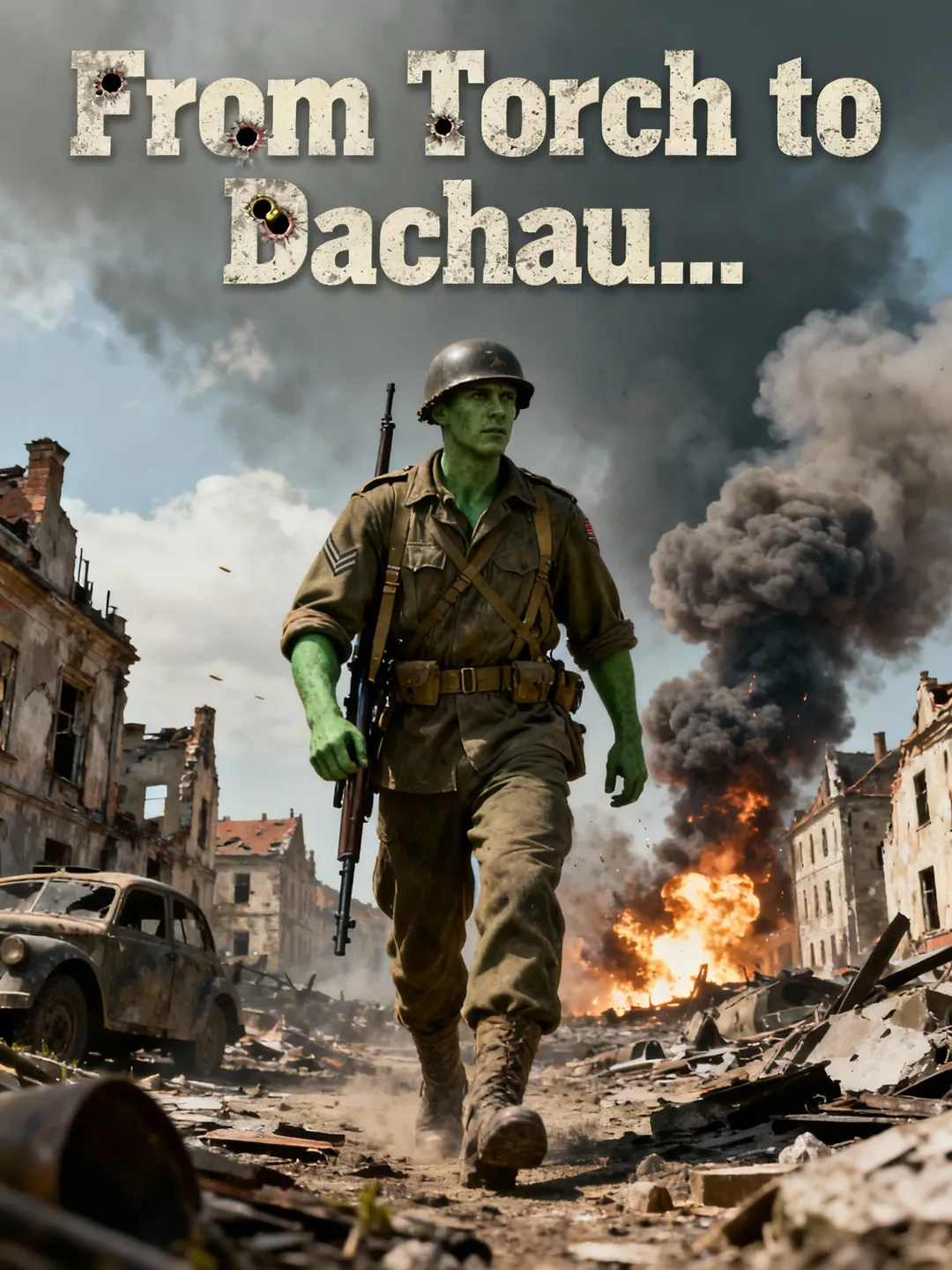
From Torch to Dachau...
ملخص
Marcus Longshore is an Orc, from the Colville/Yakima Goblinoid semiautonomous Homeland (reservation). He chose the Army while his brother chose the Marines. he will march for the duration of the war, and see things no man can un-see, and every man who bears witness wishes he could unsee.
الفصل1
The letter arrived on a Tuesday in early March, carried by the same postman who'd been delivering mail to the reservation for thirty years. Marcus Ironworker recognized the envelope the moment he saw it—thick paper, government seal, the kind that made your stomach drop even before you knew what was inside.
His mother saw him freeze in the doorway, one hand still on the screen door, the other holding the envelope like it might bite him. She set down her knitting slowly, the half-finished sock sagging in her lap.
"Marcus?" she said, and he could hear the question in her voice even though she didn't finish it.
He brought the letter to the kitchen table, sat down across from her. The envelope felt heavier than it should have, like it carried not just paper but the weight of every generation that had served before him. His father came in from the workshop, wiping grease from his hands onto an old rag, saw the envelope and stopped moving.
"Well," his father said finally. "Open it, then."
Marcus slit the envelope with his pocket knife. The paper inside was crisp, official. He read it once, then again, the words not quite sinking in.
"Assignment to the 10th Horde Regiment," he said. His voice came out steadier than he felt. "Fort Bragg. Integration program."
His mother reached across the table and took his hand. Her fingers were rough from years of work, but warm. "Your grandfather would be proud," she said, but her voice cracked on the last word.
The bus to Fort Bragg smelled like diesel and nervous sweat. Marcus sat by the window, watching the reservation disappear behind him, replaced by endless miles of pine forest that looked nothing like home. The other passengers were mostly human soldiers, young men trying to look older than they were, talking too loudly about basic training and how easy it would be.
They went quiet when they saw him. One kid actually moved his duffel bag closer to his feet, like Marcus might steal it. The silence lasted until the next stop, when more soldiers got on and the bus filled up with the kind of tension that came from people pretending they weren't scared.
Fort Bragg sprawled across the landscape like a small city, all beige buildings and razor wire. The processing center was a long, low building that smelled of bleach and old coffee. Marcus stood in line with the other new arrivals, moving slowly through stations where bored clerks took his information, stamped forms, handed him paperwork that meant nothing yet.
A sergeant with tired eyes looked at Marcus's papers, then up at him. "Integration program, huh?" He didn't wait for an answer. "Wait over there."
The waiting area was a corner of the room with plastic chairs that had seen better decades. Marcus sat next to a kid who kept tapping his foot against the floor, making the chair legs rattle. After twenty minutes, a corporal came to get him.
"Colonel Whitman wants to see you," the corporal said. "Bring your paperwork."
The colonel's office was smaller than Marcus expected, just a desk and two chairs and a window that looked out over a parade ground. Colonel Whitman stood up when Marcus entered—a tall man with gray at his temples and the kind of posture that said he'd been military his whole life. He didn't smile, but his handshake was firm.
"Private Ironworker," Whitman said, gesturing to the chair across from his desk. "Have a seat."
The interview was shorter than Marcus expected. Whitman asked about his education, his family, what he'd studied in school. He took notes in a small black notebook, nodding occasionally. When he was done, he closed the notebook and looked at Marcus directly.
"This is an experiment," Whitman said. "Some people think it won't work. Others think it's overdue. I think we'll find out which is true soon enough." He stood up. "Your barracks is Building 47. Sergeant Morrison will get you oriented. Dismissed."
The BAR-A2 was heavier than the training rifles he'd used back home. Marcus hefted it cautiously, feeling the weight settle into his hands. The sergeant showing him around—Sergeant Morrison, a stocky man with freckles and an easy smile—watched him handle the weapon with professional interest.
"Not bad," Morrison said. "Most of the kids we get, they think holding a rifle makes them soldiers. You look like you know which end the bullets come out of."
The squad was six men and two women, all human except Marcus. They were quiet as he entered the barracks, watching him with the kind of wariness that came from not knowing what to expect. The barracks smelled of new paint and old wood, with rows of bunks along both walls.
"Everyone, this is Ironworker," Morrison said. "He's going to be with us for a while. Try not to scare him off on the first day."
The introductions were awkward. Everyone used last names—Smith, Johnson, Williams, the kind of names that blended together. Private Williams, a thin kid with glasses, kept glancing at Marcus like he expected him to do something unusual. Private Johnson, older than the rest with a scar across his jaw, just nodded once and went back to cleaning his rifle.
That first night, Marcus lay on his bunk listening to the sounds of the base settling down. The other soldiers talked in low voices, careful not to wake anyone. He couldn't make out the words, but the tone was familiar—nervous bravado covering real fear.
"They're saying we can't be trusted," someone said. Marcus held still, pretending to be asleep. "That we'd turn on our own side if things got bad."
"We're not supposed to say that," another voice replied. "But yeah. That's what they're saying."
"Think it's true?"
"I don't know. They're different, you know? Not like us."
The voices faded into silence. Marcus stared at the ceiling, counting the cracks in the plaster until sleep finally came.
Three days later, he sat at a small desk in the recreation room, pen in hand, trying to find words that would make sense to his mother. The paper seemed too white, too clean for what he needed to say.
Dear Mom and Dad,
I hope this letter finds you well. The weather here is warmer than home, and the food is better than I expected. Sergeant Morrison seems like a good man—treats us all the same, or tries to.
The other soldiers are still getting used to having me around. It's not that they're unfriendly, exactly. More like they're not sure what to make of me yet. I think most of them have never really talked to someone like me before. They'll come around, or they won't. Either way, we have work to do.
Colonel Whitman called this an experiment. I think he meant it's an experiment to see if we can all fight together, not just if I can fight with them. That's a bigger thing than any of us, maybe. But we'll find out soon enough.
Tell Grandpa his stories about basic training weren't exaggerating. Everything he said was true, and then some. I think about what you told me before I left—about how change happens slowly, one person at a time. Maybe that's what we're doing here. One person at a time.
I'll write again when I can. Give my love to everyone.
Your son,
Marcus
He read the letter twice, then folded it carefully and sealed the envelope. Tomorrow they'd start real training, the kind that would turn a group of strangers into a unit. One person at a time, he thought. Maybe that was how the world changed, too.
أحدث الفصول
Marcus stood at the edge of the parade route, his uniform pressed and clean, the new stripes
The smell hit them before they saw anything. It was like nothing Marcus had ever known—not th
The wind carried the stink of burning wood and something worse. Marcus had smelled it before—
The morning air in the French village was thick with the smell of woodsmoke and something els