
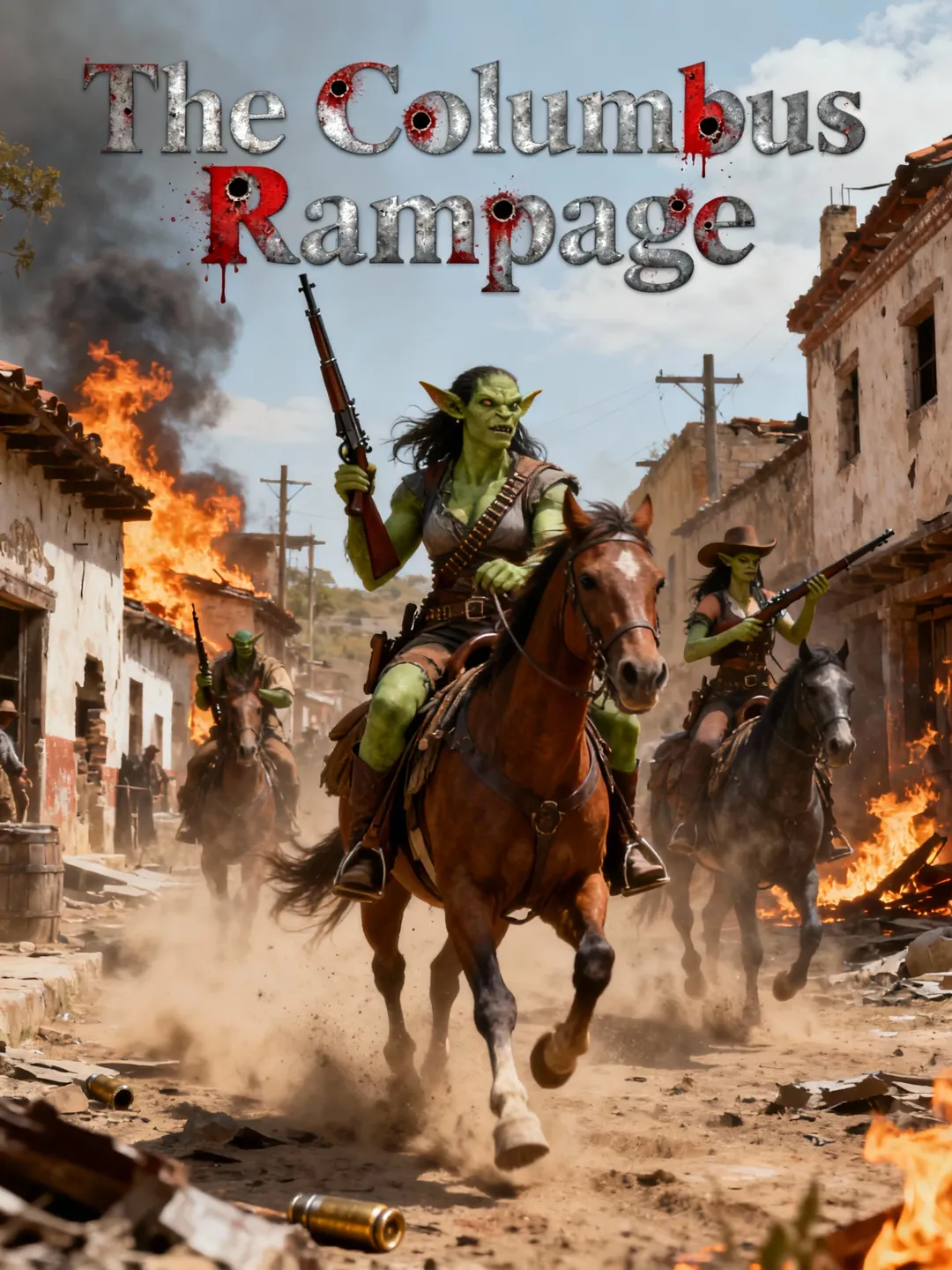
The Columbus Rampage
ملخص
https://en.wikipedia.org/wiki/Battle_of_Columbus_(1916)
but what if things were different? In the world of Gaia (Sol III, occasionally mistermed 'earth' by fans of environmentalist causes) Pancho Villa kicked an anthill, as Columbus New Mexico was a trading port with the Los Alamos Semiautonous Goblinoid Homeland. He might've gotten away with it, since the Horde Regiments First Tier, or 'serving soldiers' were in Europe at the time, leaving only women, children, and those too old to deploy. Unfortunate for him, and for Northern Mexico as a whole, the Women's Committee of the Los Alamos (New Mexico and Arizona), Split Rock (Nevada), and Stone Canyon (Utah) Semiautonomous Goblinoid Homelands decided Pershing's expedition wouldn't do the job.
Thus beginning a two year rampage alternately hunting Villa, and stripping Northern Mexico of every healthy male below the age of fifteen...
الفصل1
The first light found Amanda already awake, sitting at the kitchen table with her hands wrapped around a cup of coffee gone cold hours ago. The house felt wrong - too quiet, like it was holding its breath. When her mother came in from the yard, Amanda didn't need to ask what had happened. The blood on her hands said everything.
Her mother knelt on the floor with a bucket of water that had already turned pink, scrubbing at the boards with a brush that made soft, wet sounds. Over and over, the bristles scraped across the wood, making that same rhythm. Drip. Scrape. Drip. Scrape. Amanda watched the muscles in her mother's back working under the thin cotton dress, watched the gray streaks in her hair that hadn't been there last week.
"They came just after moonset," her mother said without looking up. "Luis saw them first, running toward the river. But they turned back when they saw the smoke."
Amanda set down her cup. It made a small clink against the table. "Who?"
"Mexicans. Soldiers. I don't know." Her mother's voice was flat, like she was talking about someone else's life. "They shot the dogs first. Then they started with the houses."
The water in the bucket was getting darker. Amanda could smell it from across the room, that sweet-copper smell that made her stomach turn. She'd never seen her mother scrub floors before - they'd always had Rosa for that, back when they had Rosa and a house with carpets and glass in all the windows.
"How many?"
"Twelve boys. Maybe more." Her mother sat back on her heels. The brush slipped from her fingers and clattered against the bucket. "They lined them up against the church wall."
Amanda's younger brother had been twelve last spring. She found herself counting in her head - twelve boys, twelve mothers, twelve empty places at twelve dinner tables. The numbers felt too small to hold all that grief.
Her mother started scrubbing again, harder this time. The sound of the bristles against the wood got louder, more desperate. Amanda could see her shoulders shaking, but she made no sound at all.
The plaza was full when they got there, people standing shoulder to shoulder like they were holding each other up without touching. Amanda's mother had changed into her good dress, the black one she saved for weddings and funerals. She walked with her back straight, the way she used to walk into church when Amanda's father was still alive.
Abuela Stonebreaker stood on the steps of the church, her voice carrying over the crowd like the tolling of a bell. She was older than the church itself, people said, older than the river that ran behind it. Her hands shook as she held the paper, but her voice never wavered.
"Manuel Ortega," she read. "Fourteen years. Shot through the heart."
Someone in the crowd made a sound like a wounded animal. Amanda felt her own heart stop for a moment, then start again too fast.
"Jose Martinez. Thirteen years. Shot through the head."
The names went on and on. Each one was a boy she'd known since they were all babies together. Each one had run through her yard chasing chickens, had stolen peaches from her mother's tree, had grown up right alongside her like weeds in a garden. She could see their faces in her mind - Jose with the gap in his front teeth, always grinning. Manuel who was going to be a doctor like his uncle. Little Pedro who'd cried when his dog died last winter.
"And we will answer," Abuela Stonebreaker said when the last name had been read. Her voice had changed, become something harder. "Measure for measure. Blood for blood."
The crowd murmured agreement, a sound like bees in a hive. Amanda felt it in her chest, that same buzzing, that same need to do something, anything, that wasn't just standing here waiting for the next list of names.
She found herself walking toward the shed before she'd made the decision to go. It stood behind her great-uncle's house, half-hidden by overgrown sagebrush and the twisted trunk of an old apple tree. The door creaked when she pushed it open, loud in the quiet afternoon.
Inside, it smelled of oil and old leather and something else she couldn't name. The Mauser hung on pegs over the workbench, its barrel gleaming dully in the light that came through the single window. She reached up with both hands, the metal cold against her palms.
It was heavier than she'd expected. She'd held her father's rifle once, years ago, but this felt different. This was hers now, in a way her father's had never been. She ran her fingers along the stock, feeling the smooth wood worn soft by someone else's hands. Somewhere, someone had carved initials into it - not hers, but they would be soon.
She found the rusty nail in the dirt floor, bent but still sharp. It took her three tries to scratch her name into the wood, the letters small and uneven but clear. A-M-A-N-D-A. She added the date underneath, the way she'd seen soldiers do in the old photographs. November 1864. The day she stopped being just someone's daughter.
That night, the moon was so bright it made shadows on the floor of her room. She'd packed a small bundle - one dress, one pair of extra shoes, the photograph of her family from before her father died. She left the coffee cup on the table, still half-full of cold coffee. She left her mother's brush on the dresser, still tangled with gray hairs.
Her mother was waiting by the door. She'd been crying - Amanda could see that by the way her eyes were red - but she wasn't crying now. She just stood there in her nightgown, looking older than she had that morning.
"You don't have to do this," she said.
"Yes, I do."
They stood looking at each other across the small space that had always been too small to hold everything they weren't saying. Amanda could hear her mother's breathing, quick and shallow, like she'd been running.
"Take this," her mother said, holding out a small cloth bag. "It's the coffee. The good kind, from the store. And there's hard candy, the kind you used to like."
Amanda took the bag. It was warm from her mother's hand.
"Be careful," her mother said. "Come back."
Amanda kissed her cheek. Her mother's skin was soft and smelled of the lavender water she used to put on before church. "I will."
Outside, the column was already forming, girls she knew and girls she didn't, all moving together like one long shadow in the moonlight. They moved quietly, the only sound the soft thud of boots on dirt and the occasional jingle of a harness.
Amanda slung the rifle across her back, the strap cutting into her shoulder through her coat. She took her place in the line without speaking. The girl in front of her had her mother's shawl tied around her neck. The girl behind her was humming under her breath, a song Amanda didn't know.
They started walking south, following the road that led away from everything familiar. The moon lit the way like someone had spilled a bucket of milk across the ground, white and bright and impossible to clean up. Amanda didn't look back at the house with the light still burning in the window. She didn't look back at her mother standing in the doorway.
She walked with her head up, the rifle bouncing against her hip with each step, following the girls who were following the road that would take them to wherever they were going. Behind them, the town got smaller and smaller until it was just a few lights in the distance, like stars that had fallen to earth.
Ahead, the road stretched out under the moon, straight and white and endless.
أحدث الفصول
<p>
The sky was barely gray when Amanda shifted her weight from one foot to the othe
The morning light came through the high windows of the training hall in thin bars, making str
The morning sun felt warm on Amanda's face as she stood in the small adobe building that had
The mud had dried to a crust on their boots by the time they reached the camp, but the smell