
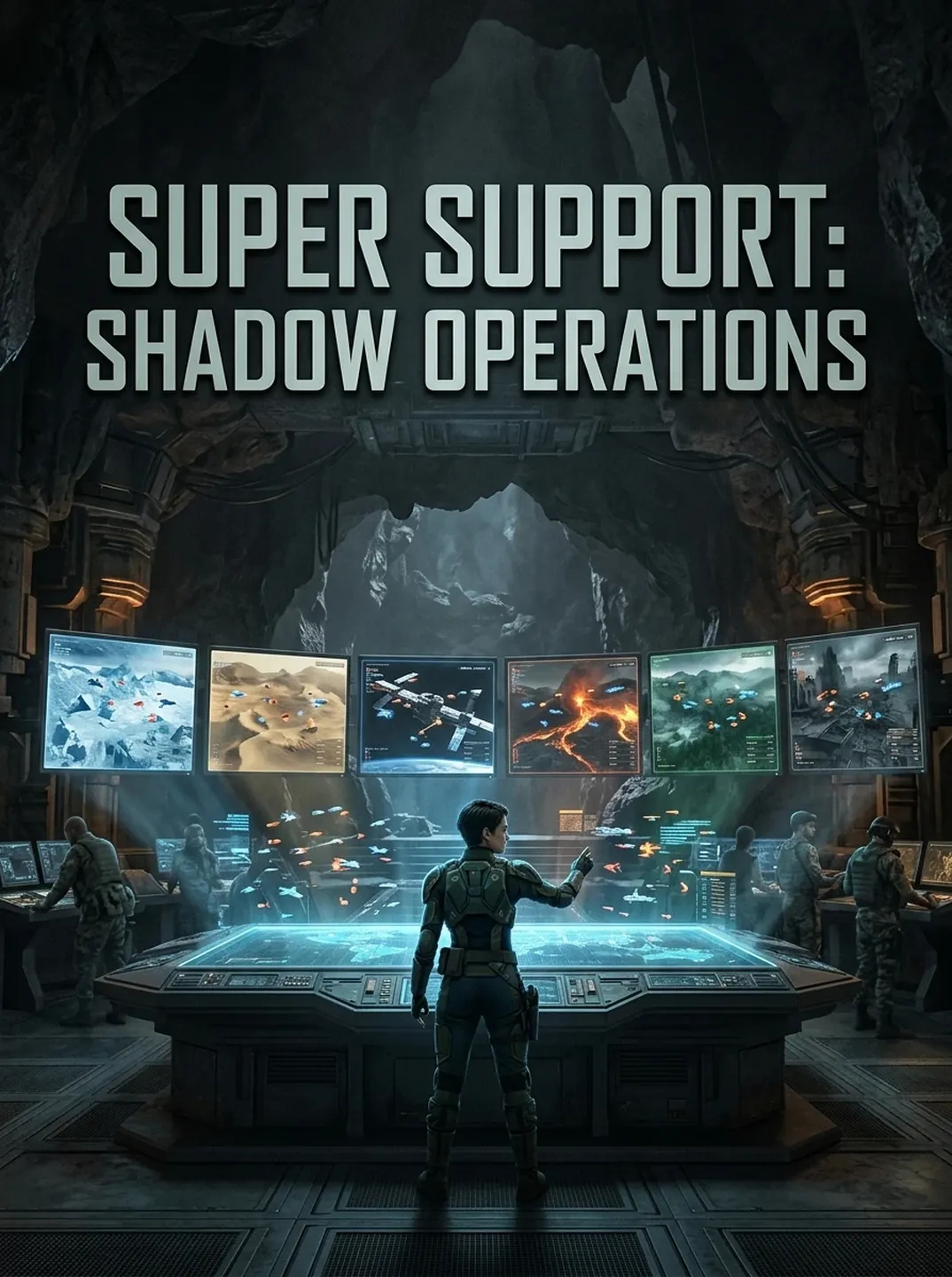
SUPER SUPPORT: SHADOW OPERATIONS
ملخص
A Support-Class hero coordinates six worlds against extinction — without firing a shot.
الفصل1
Lena Cross woke at 5:47 AM on a Tuesday in late September, thirteen minutes before her alarm, which was precisely how she preferred her mornings — calm, predictable, and blessedly free of other people's emergencies. She lay still for a moment in the grey half-light filtering through her curtains, listening to the city below begin its daily transformation. Somewhere on the floor below, her roommate's alarm was already going off — a tinny, determined beep that Lena had heard every weekday for the past two years. She did not mind. It was part of the rhythm of the building, like the pipes that clanked at six AM sharp every morning, or the elderly man on the fourth floor who started his radio at exactly the same frequency every single day.
She made coffee in a battered French press that had been her mother's before it was hers, measuring the grounds with the same casual precision she applied to everything — not too fine, not too coarse, exactly three heaped tablespoons for two cups, filtered water at ninety-three degrees, a four-minute steep. She had read somewhere that the optimal extraction time for French press was four minutes, and she had taken that information and filed it in the part of her brain labelled 'things that are worth knowing precisely.' She poured the coffee into a thermos — the good one, the stainless steel one that actually held heat for six hours — and carried it up two flights of stairs to the roof access door. The building super had told her technically it was not allowed, but he also left the roof access door unlocked and had never once said anything about the folding chair she had quietly placed up there. She suspected he knew exactly what she was doing and had made peace with it.
The roof at 5:47 AM was still mostly dark, the city held in that brief suspended moment between night and day when everything seemed possible. The streetlights were still on below, casting orange pools on the pavement, and the first delivery trucks were beginning their routes through the empty streets. The sky was the color of a bruise — deep purple at the horizon bleeding into dark blue overhead — and the air had that particular autumn sharpness that made her think, every year around this time, of all the things she had not yet done and all the things she was glad she had already finished.
She sat in her chair, thermos beside her, and watched the city wake up.
It began with the lights. Not the streetlights — those were on timers and obeyed their schedules with machine precision — but the lights in apartment windows, in office buildings, in the twenty-four-hour convenience store on the corner that never seemed to have a time of day when it was not brightly lit. One by one, windows flickered on. A neon sign across the street buzzed into life. Three floors down, someone was already cooking something that smelled aggressively of garlic. A pigeon landed on the ledge beside her chair, studied her with the air of profound suspicion that pigeons universally brought to every interaction, and then flew away again.
Lena did not mind the early hour. In fact, she had come to treasure it — this forty-minute window between waking and the official start of the day, when the city belonged to no one and everyone at once, when the air was cool and the obligations of the day had not yet accumulated into their full, pressing weight. She used this time the way other people used meditation or exercise: to think. Not about anything in particular. Just to let her mind move through the information it had absorbed the day before, to make connections between things she had noticed.
At twenty-six, Lena had already developed a reputation among her friends and colleagues for being unusually methodical. She kept lists. She colour-coded her calendar. She had a system for triaging her email inbox that she had written out in a four-page document and shared with exactly no one, not because she was secretive but because she suspected that explaining it would require more energy than simply continuing to do it. She worked as a hospital administrator at St. Christopher's on the east side, a job she had fallen into after graduating with a degree in Health Policy that she had chosen partly because it combined her interest in systems with her genuine desire to help people.
She had been at St. Christopher's for four years now, working her way up to departmental administrator for the emergency medicine division, which meant she was responsible for coordinating staffing schedules, supply procurement, compliance reporting, and — the part of the job she cared about most — the smooth running of the department's daily operations, which in practice meant solving a constant stream of small problems before they became large ones.
She was good at it. This was not vanity; it was observation. The ones who did the job well shared key traits: they were systematic, they were attentive to small details, and they understood that the emergency department was not a collection of individuals but a system — an interconnected machine in which every moving part needed to be in the right place at the right time, and in which the most important skill was not brilliance but reliability. Lena was reliably good. She showed up. She paid attention. She noticed things other people missed. She wrote things down so she would not forget them. She followed up.
These were not glamorous skills. Nobody ever wrote a song about the administrator who made sure the right equipment was in the right place at the right time. But Lena had long ago made her peace with the unglamorous nature of her work. She had a theory — one she had quietly written in her journal under the heading 'Core Operating Principles' — that the most important work in any organisation was almost always invisible.
At 5:52 AM, the words appeared.
They did not appear on her phone. Her phone was in her jacket pocket, on the kitchen counter, approximately forty meters away and behind two locked doors. It had four percent battery remaining. The words were not on the building wall opposite, which she could see clearly from her angle on the roof, nor were they projected from any device she could identify. They simply materialised in the air in front of her face, floating at eye level, rendered in a font she had never seen before — thin, angular characters that seemed to have been borrowed from a military command interface and then dressed up with enough aesthetic refinement to look almost elegant.
She reached out with her right hand. Her fingers passed through the words the way they would have passed through smoke. The words stayed exactly where they were, indifferent to her touch.
[SYSTEM INTEGRATION - HERO REGISTRATION PROGRAM - INITIALIZING]
[Designation: Support-Class - Tier 1]
[Role: Combat Coordination and Ally Enhancement]
[Skill Unlocked: [Reinforce Ally] - Target primary stats +20% for 15 minutes. Mana cost: 30. Cooldown: 10 minutes.]
Lena read the notification three times.
She was a methodical person. When presented with new information, her instinct was to read carefully, note key data points, and defer judgment until she had sufficient context to form an accurate assessment. She applied this instinct now. She noted the word 'Support-Class,' the word 'Tier,' the phrase 'Combat Coordination.' She noted that the word 'hero' did not appear anywhere in the notification.
She finished her coffee and walked home. She plugged her phone in to charge and typed: 'Support-Class hero Tier 1 what does it mean.'
The results were, in a word, unhelpful. The first page of results was dominated by fan forums with feverish speculation — posts arguing Support-Class was the most powerful class and posts arguing it was the least powerful. She spent two hours reading. She made notes. She did not come to a conclusion, but she came to a preliminary working hypothesis: that Support-Class was a real designation, and that the online speculation was approximately eighty percent noise.
She had spent six years working in hospital administration. She had coordinated medical teams during a flu pandemic. She had organised the evacuation of forty-seven patients during a flooding emergency with two hours notice. She had built a mental model of crisis management through sheer repetition until the process of coordination — reading a situation, identifying the key variables, making fast decisions, communicating clearly — felt as natural to her as breathing.
The System had called her Support-Class. It had given her a skill called [Reinforce Ally]. It had rated her Tier 1.
She wrote in her notebook that afternoon under the heading she had been using for three years: What I Actually Do.
Support was not the hero world's janitor, she wrote. Support was its architecture.
She underlined it twice. And then, beneath it, she added: We will see about that.
The System notification had said she was Tier 1. She intended to be Tier 0 by this time next year. She was Lena Cross, Support-Class, Level 1. And she was ready for whatever came next.
أحدث الفصول
The years after Lena's retirement were defined by something she had never expected: the exponent
The anniversary of the World Convergence Event was declared an international holiday across all
The year after the World Convergence was, in many ways, the hardest of Lena's life — not because
The year after the World Convergence was, in many ways, the hardest of Lena's life — not because
الوسوم
قد يعجبك أيضاً
لا توجد توصيات
لا توجد توصيات حاليًا - يرجى مراجعة الموقع لاحقًا!