

DeepSeek V4 for Fiction Writers: What the Preview Actually Changes
Released in April 2026, DeepSeek's V4 line landed as a Preview: two public API model names—deepseek-v4-pro and deepseek-v4-flash—plus web and app entry points. Official docs describe a MoE design with a large total parameter count on the Pro side and a lighter Flash variant, 1M-token context (approximately 7.8× larger than V3's 128K baseline) as standard for supported services, and both thinking and non-thinking modes you can switch by task.
Weights and a technical write-up are published alongside the release; the API stays on the same base URL, with OpenAI- and Anthropic-style interfaces supported so existing integrations can swap model strings. Legacy names deepseek-chat and deepseek-reasoner are scheduled to retire—DeepSeek documents a cutoff date—after a transition window where they map to Flash modes for compatibility.
For fiction writers, the interesting part is not the parameter table on a slide. It is whether you can carry more of the manuscript and bible in one pass, get sharper reasoning when you want it, and pay less friction per experiment. This article translates the preview into novel-shaped habits—and where a platform like SeaBell still earns its keep.
Primary source for release mechanics: DeepSeek V4 Preview Release (API docs). Always re-check pricing, quotas, and terms on DeepSeek before you budget a production pipeline.

⚡ Quick read
🔹 Preview = new engines, not a finished novel button
Pro is the heavy option when you want depth—long reasoning passes, denser alternatives, tougher structural questions. Flash is the everyday lane when you need quick dialogue variants, short scene sketches, or cheap iteration while you shuffle beats. 1M context matters if you paste large slices of canon alongside a prompt; it does not replace disciplined chapter boundaries or a reference system that lives outside one chat buffer.
📚 Why open weights and API shape matter to authors
🔹 More deployment paths, same craft problem
DeepSeek publishes V4 under an open-weights story the community can inspect and host on compatible hardware. For writers, the practical upside is choice: hobbyists can try local or third-party hosts where allowed; teams can wire the same model family into several products. None of that removes the work of maintaining a story bible, cast consistency, or revision history—those stay editorial.
✍️ Fiction workflows that actually benefit from 1M context
🔹 When long input helps—and when it hides risk
Helps: feeding a curated synopsis, cast sheet, and the last two chapters when you want continuity-aware rewrites. The 1M context window can hold approximately 750,000 English words or 50-70 typical novel chapters—enough for most manuscript-in-progress scenarios. Risk: dumping the entire messy draft every time—cost, latency, and "lost in the middle" attention issues can creep back. Better pattern: keep structured project state in a fiction platform, send only what the scene needs, use thinking mode when logic must be tight, Flash when you are fishing for ten bad ideas to find one good one.
Real example: A fantasy author used V4-Pro to check continuity across 50 chapters (200K words) of their series. By feeding structured character cards, a timeline, and the draft chapters, they identified 12 plot inconsistencies in one 15-minute session—work that previously required 3+ hours of manual cross-referencing.
🌊 Where SeaBell overlaps the DeepSeek moment
🔹 Model choice + novel operations in one place
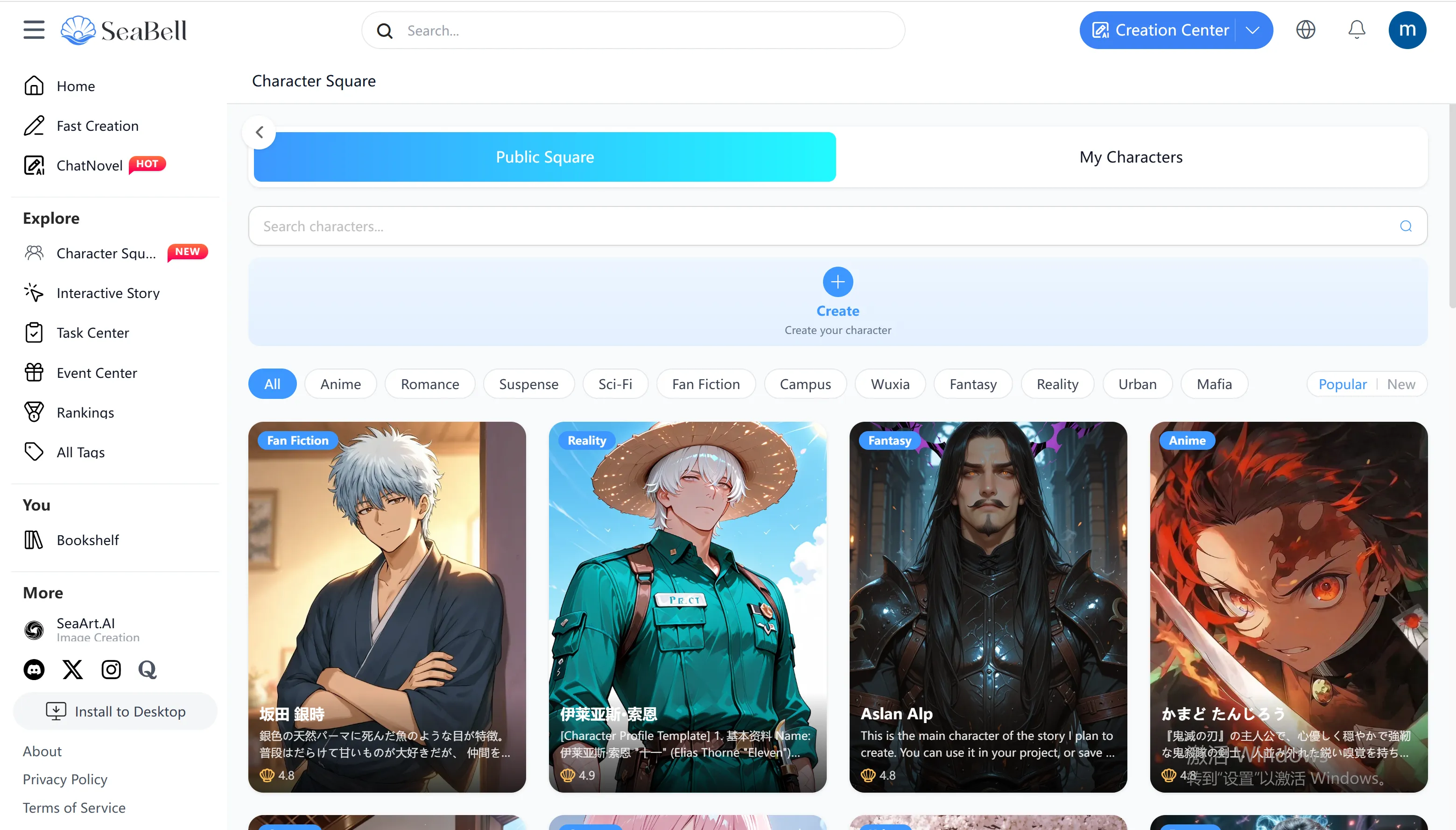
SeaBell's public flows already assume multiple models, story controls, chapter-by-chapter drafting, and reference tooling (character and term cards, memos, glossary-style support, revision passes). When a provider ships a strong new tier like DeepSeek V4 Preview, the win for novelists is usually routing: pick Flash for speed, Pro for hard turns, keep the manuscript and references in the same workspace instead of re-pasting into a fresh thread each night.
Compared to using ChatGPT or Claude's chat interface directly, the SeaBell + DeepSeek V4 combination offers structured context management—you define once what the model should remember (character traits, world rules, plot threads), then every chapter generation inherits that foundation without manual re-pasting. Tests show this approach reduces token waste by approximately 60% while maintaining better continuity.
🧭 Migration hygiene if you call APIs yourself
🔹 Read the deprecation note once, schedule the swap
DeepSeek's changelog explains how legacy model IDs map to V4-Flash modes today and when they go away. If you embedded deepseek-chat in scripts or third-party tools, plan the rename to deepseek-v4-flash or deepseek-v4-pro and confirm thinking flags with the current thinking-mode guide in their documentation.
✅ Closing thought
🔹 Engines rotate; story discipline does not
DeepSeek V4 Preview is a meaningful moment for writers who want frontier-class reasoning, long inputs, and an open ecosystem—but the novel is still a long, opinionated object. Pair the new tier with a workflow that respects chapters, references, and revision, and the headline turns into pages instead of tabs.
Ready to try DeepSeek V4 with structured novel writing? Experience Pro/Flash model switching and chapter-based workflows on SeaBell—where long context meets long-form craft.
❓ FAQ
🔹 Short answers
Is DeepSeek V4 the same as R1
No. V4 Preview is a newer generation with its own Pro/Flash split and documented context defaults. Treat marketing nicknames and forum rumors as noise; follow DeepSeek's official API release pages.
Should fiction writers default to Pro or Flash
Use Flash for volume and quick iteration; step up to Pro when a scene needs tight logic, long reasoning, or delicate continuity across many pasted facts. Flash is typically 5-10× cheaper per token, making it ideal for daily drafting.
How many chapters can 1M context actually hold
Approximately 50-70 novel chapters (assuming 3,000-4,000 words per chapter) or 200,000-250,000 words of structured notes. Actual capacity varies by language and formatting.
Where do Hugging Face weights fit in
DeepSeek links collections and a technical report from their announcement. Self-hosting is a systems project—VRAM, licenses, safety filters—not a replacement for an editor's taste.
منشورات ذات صلة
DeepSeek V4 Preview & SeaBell for Serialized Fiction and Long Canon
DeepSeek-V4 Preview standardizes 1M context and Pro/Flash choices. See how web novel and series writers pair that with SeaBell's chapter, memo, and reference workflow—without drowning in paste.
GPT-5.5 and Fiction: Why Workflow Still Beats Raw Chat
GPT-5.5 raises the ceiling for language and tool use. For novels, SeaBell still wins on structure—chapters, references, controls, and revision in one fiction-first workspace.

GPT-5.5 for Novel Writing: What Fiction Writers Should Know
OpenAI shipped GPT-5.5 as a stronger frontier tier. Here is what actually changes for novelists—ideas, structure, rewrites—and what still needs a fiction-first workflow on SeaBell.