

200+ Creative Writing Prompts by Genre, Skill Level & Style
If you have ever stared at a blank page for longer than you care to admit, this page is for you. A good creative writing prompt does more than hand you an idea. It gives you friction: a character who wants something, a situation that will not sit still, or a question that makes the next sentence easier to write.
Most prompt lists stop there. They throw 500 ideas at you and call it a day. Useful? Sure. Complete? Not really. You still have to figure out how to turn one sentence into a scene, a premise, or a story that actually holds together.
That is the gap this page tries to fill.
This guide includes 210 creative writing prompts organized by genre, skill level, craft focus, and story length. Beginners can start with short, low-pressure prompts. Writers looking for creative writing prompts for adults can use the advanced sections to break habits, test darker premises, or build more layered characters. If you want an AI-assisted path, it is here too, but it stays in the role of a drafting partner rather than taking over the work.
Quick definition: Creative writing prompts are short ideas, questions, or scenarios designed to help writers start a scene, story, poem, or draft. The best prompts create conflict, curiosity, or emotional pressure instead of simply naming a topic.
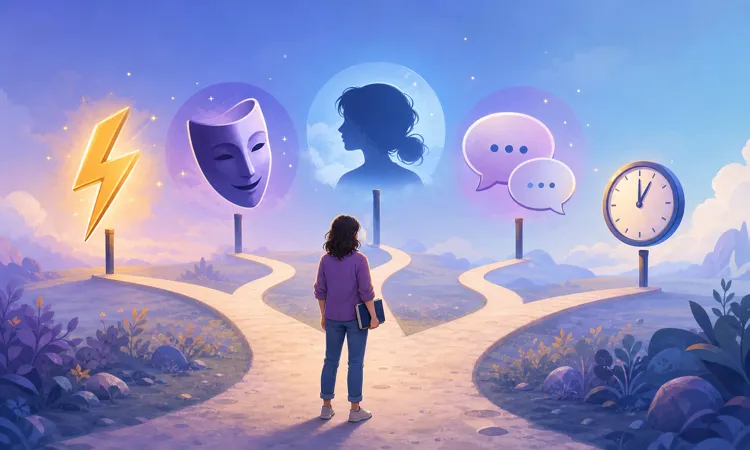
🧭 Which Creative Writing Prompt Should You Choose?
The best creative writing prompt is not always the strangest one. It is the one that gives you a character, a pressure point, and a reason to keep going after the first paragraph.
- If you feel stuck: choose a one-line story starter and write for 10 minutes.
- If your plots feel thin: choose a mystery, thriller, or fantasy prompt with a clear external problem.
- If your characters feel flat: use the character development and relationship prompts.
- If your scenes feel lifeless: use the dialogue prompts focused on subtext and tension.
- If you want a finished piece quickly: choose a flash fiction prompt with a 300-800 word target.
🧩 Types of Creative Writing Prompts
| Prompt Type | Best For | Example |
|---|---|---|
| Story starter | Blank-page momentum | The letter was postmarked six years in the future. |
| What-if prompt | Speculative ideas and unusual premises | What if every lie left a visible mark? |
| Character prompt | Backstory, motivation, and emotional conflict | Write the worst lie your character ever told. |
| Dialogue prompt | Subtext, tension, and distinct character voice | Write a breakup conversation where no one says “breakup.” |
| Flash fiction prompt | Short drafts and daily writing practice | Write the last five minutes of a friendship in real time. |

🛠️ How to Use Creative Writing Prompts Effectively (Before You Start)
Most writers treat prompts like lottery tickets. They scroll, they hope, and they move on when nothing jumps out. That is usually the wrong move. A plain prompt used well will beat a brilliant prompt you never finish. The University of Wisconsin Writing Center guide to invention techniques is a useful reference for freewriting, listing, asking questions, and other ways to generate material before drafting.
For Beginners: Start With Easy Prompts and Build Up
If you are new to creative writing, the trap is not laziness. It is overreaching. You see a huge prompt, try to solve the whole story at once, and the page wins.
Start smaller. I like a simple three-step approach:
Step 1: React first. Pick one prompt from the story starter section and write for 10 minutes without stopping to polish. If that feels too loose, use George Mason University’s brainstorming techniques to warm up with listing, freewriting, or focused questions before you choose a direction.
Step 2: Expand one moment. Find the part that feels alive and turn that slice into a full scene. Give the character a want. Give them a problem. Let the scene push back.
Step 3: Add the next beat. Move forward or backward in time, but only one step. Two connected scenes already feel like a story.
For a low-pressure start, use the one-line story starters or the flash fiction section first. Choose a prompt tagged [Beginner-Friendly] and write one scene instead of planning a whole story.
For Experienced Writers: Use Prompts to Break Patterns
If you have been writing for a while, prompts are most useful when they break your routine. Not because you need more inspiration, but because you probably have a few habits that are getting too comfortable.
Try a genre you normally avoid. Put a hard constraint on the page. Rewrite a scene in a voice you do not usually use. That is where the good friction lives.
The "what if" prompt is especially useful here. One odd rule, one strange reversal, one small impossibility — that is usually enough to shake loose a new story.
Look for the [Advanced] tags in the genre sections, and do not skip the character and dialogue sections. Those are usually the places where stronger writers get the most out of a prompt.
How AI Can Help You Expand Any Prompt Into a Full Story
AI is useful here for a very simple reason: it shortens the distance between a prompt and a workable draft. That is all. It does not replace the writing, and it does not make the decisions for you.
A useful rule: ask AI for options before you ask it for prose. Options keep you in control; full drafts too early can make the story feel generic. A practical workflow looks like this:
- Start with a prompt from this page.
- Ask AI to turn it into a one-paragraph premise.
- Use follow-up questions to shape the characters, stakes, and twist.
- Draft a scene, then revise it in your own voice.
That sequence matters because it keeps the creative control with you. The tool helps you move faster. It does not do the thinking for you.
Try it yourself: If you like using AI as a brainstorming partner, SeaBell's AI novel writing workflow can help you turn a prompt into a premise, outline, and early draft while still leaving the final voice and decisions to you.
⚡ Short Creative Writing Prompts and Story Starters to Start Writing Fast
Sometimes you do not need a full premise. You just need one sentence that gives you something to push against. That is what the short prompts are for: fast starts, no setup, no ceremony.
If you came here for creative writing prompts story starters, this is the quick version.
One-Line Story Starters (Just Finish the Scene)
Each of these story starters gives you a character in a moment. Your only job: keep writing. Don't think about where it's going. Just follow the sentence and see what happens next.
They also work as simple creative writing prompts examples if you want to see how a one-line idea can still carry tension.
- She opened the front door and found a suitcase that hadn't been there an hour ago.
[Beginner-Friendly][5-Min Exercise][Mystery] - The letter was postmarked six years in the future.
[Beginner-Friendly][Sci-Fi/Thriller] - He hadn't spoken to his brother in a decade, but there he was, sitting in the kitchen like no time had passed.
[Beginner-Friendly][Literary/Drama] - The dog came back from the woods with someone else's wedding ring in its mouth.
[Beginner-Friendly][5-Min Exercise][Mystery/Romance] - She woke up fluent in a language she'd never studied.
[Intermediate][Fantasy/Sci-Fi] - The power went out citywide at exactly midnight, and when it came back, every clock showed a different time.
[Intermediate][Thriller] - He found a handwritten note tucked inside a library book: "If you're reading this, don't go to the park on Friday."
[Beginner-Friendly][5-Min Exercise][Thriller] - The old woman next door asked him to water her plants while she was away. She never came back.
[Beginner-Friendly][Mystery] - On her first day at the new school, everyone already seemed to know her name.
[Beginner-Friendly][5-Min Exercise][YA/Thriller] - The GPS told him to turn left. There was no road to the left — just an open field and a single chair.
[Intermediate][Literary/Horror] - She found her own journal entry — dated tomorrow.
[Beginner-Friendly][Sci-Fi/Thriller] - Three strangers on a train realize they're all heading to the same funeral.
[Intermediate][Literary/Mystery] - The lighthouse keeper hadn't had a visitor in two years. Then a boat washed ashore with no one in it.
[Beginner-Friendly][5-Min Exercise][Gothic/Mystery] - Someone is leaving fresh flowers on her porch every morning. She lives alone on a mountain road.
[Intermediate][Horror/Romance] - He applied for a job he didn't remember applying for — and got called in for a second interview.
[Advanced][Thriller/Absurdist]
"What If" Prompts to Spark Unexpected Stories
"What if" is the most powerful question in fiction. It takes something familiar and bends it just enough to make a story inevitable. Each of these prompts can go in wildly different genre directions — the notes in brackets are suggestions, not limits.
- What if you received a text message from your own number? → Could become a psychological thriller, a sci-fi time-loop story, or a dark comedy.
[Intermediate] - What if every lie you told left a visible mark on your skin? → Dystopian social drama, fantasy world-building, or a coming-of-age story about honesty.
[Beginner-Friendly] - What if one person in the world could never be photographed — and you just met them? → Urban fantasy, conspiracy thriller, or a quiet literary portrait.
[Intermediate] - What if you found proof that your memories before age 10 were implanted? → Sci-fi, psychological horror, or a family drama about identity.
[Advanced] - What if a city's entire population fell asleep for exactly one minute at the same time every day? → Social sci-fi, dystopian thriller, or a quirky literary premise.
[Intermediate] - What if you could only see ghosts when you were angry? → Supernatural horror, a grief story, or a dark romance.
[Beginner-Friendly] - What if an artist's paintings started predicting real events — but only tragedies? → Gothic horror, mystery, or a meditation on creative responsibility.
[Intermediate] - What if two strangers discovered they've been dreaming each other's dreams? → Romance, psychological thriller, or metaphysical literary fiction.
[Intermediate] - What if you woke up and everyone in your life treated you as if you'd been gone for five years — but for you, it was just last night? → Sci-fi, suspense, or a family drama about loss and time.
[Advanced] - What if animals could talk, but only to one person, and that person was on trial for murder? → Courtroom drama, fantasy, or absurdist fiction.
[Intermediate] - What if there was a room in your house that only appeared on certain nights? → Horror, portal fantasy, or a psychological character study.
[Beginner-Friendly] - What if a historical figure left behind a secret diary — and it contradicts everything we know about them? → Historical fiction, conspiracy thriller, or literary mystery.
[Advanced] - What if silence was physically painful? → Dystopian, sci-fi, or an allegory about communication.
[Intermediate] - What if you inherited a bookshop and found a shelf of books that hadn't been written yet? → Fantasy, literary fiction, or a cozy mystery.
[Beginner-Friendly] - What if you could trade one year of your life for one perfect day — and someone offered you the deal? → Romance, philosophical drama, or speculative fiction.
[Advanced]
AI Tip: Pick one story starter from this section and test it in SeaBell AI story generator. If the idea quickly produces characters, conflict, and a second scene, it probably has enough tension to keep developing.
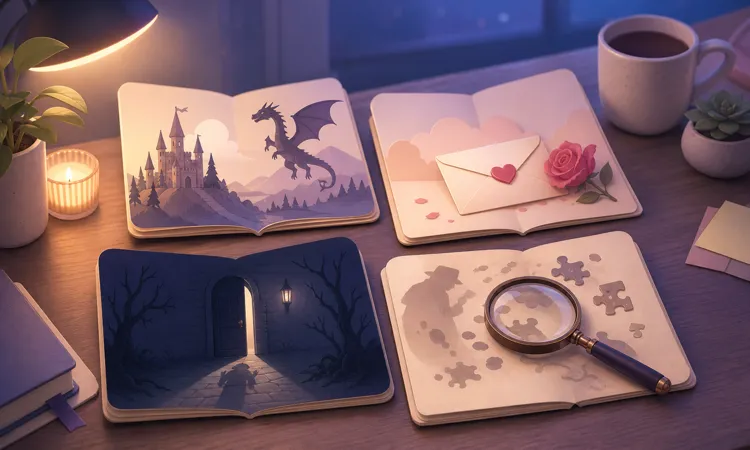
🎭 Creative Writing Prompts by Genre: Fantasy, Romance, Horror, and Mystery
This is the core of the page: 120 fiction writing prompts across fantasy, romance, horror, and mystery. Each genre includes beginner-friendly ideas, more advanced premises, and prompts designed to create real story pressure rather than just a setting.
If you already know your lane, jump there. If not, pick the section that feels least familiar. That is often the one that gives you the best material.
Fantasy Writing Prompts (30 Ideas)
Fantasy works best when it feels specific. Magic needs rules. Power needs a cost. Even the strangest worlds feel stronger when the details are concrete enough to touch.
Epic / High Fantasy
- A kingdom's magic is fueled by a finite underground lake. It's running dry, and two factions disagree on whether to ration it or find the source.
[Intermediate] - A general who has never lost a battle learns that her victories were secretly ensured by a court sorcerer — without her knowledge or consent.
[Advanced] - The last dragon isn't dying. It's refusing to eat. A young scholar is sent to find out why.
[Beginner-Friendly] - A mapmaker discovers that the borders of the kingdom shift each morning, and no one else seems to notice.
[Intermediate] - Two rival princes agree to a temporary truce to survive a pilgrimage through a cursed forest. By the time they emerge, neither wants the throne.
[Advanced] - A healer who can cure any wound discovers she can only do it by taking the injury into her own body. She's running out of room.
[Intermediate] - A farmer finds an ancient sword in his field. It doesn't make him stronger — it makes him hear the voices of everyone the sword has killed.
[Advanced] - An exiled queen returns to reclaim her throne, only to find her people don't want a monarch anymore.
[Intermediate] - In a world where everyone is born with a single-use magical ability, a boy is born with none — until his twelfth birthday, when he discovers he can steal others'.
[Beginner-Friendly] - A treaty between humans and elves has held for 300 years. A human child is born with elven features, and both sides want to claim her.
[Advanced]
Urban Fantasy & Magical Realism
- A barista discovers she can taste people's emotions in their coffee orders. The regular who orders black coffee every morning has no flavor at all.
[Beginner-Friendly] - A street musician's songs literally change the weather. He's been busking in the same spot for years, keeping a drought at bay without anyone knowing.
[Intermediate] - A librarian in Brooklyn finds a door in the basement that opens to a different city every Tuesday.
[Beginner-Friendly] - After a near-death experience, a woman can see thin red threads connecting people — but some threads lead nowhere.
[Intermediate] - A tattoo artist's ink comes to life at night. A client comes in asking for a tattoo of a person who's been dead for ten years.
[Advanced] - In a small coastal town, the tide brings in objects from people's pasts. One morning, it brings in something from the future.
[Intermediate] - A rideshare driver picks up a passenger who gives directions to an address that doesn't exist — but the GPS finds it anyway.
[Beginner-Friendly] - A woman inherits her grandmother's recipe box. Each recipe, when cooked, triggers a vivid memory that isn't hers.
[Intermediate] - A photographer realizes that the backgrounds of his portraits contain places the subjects have never been — but will visit later.
[Advanced] - Every full moon, a used bookstore rearranges itself. The owner has learned to read the new arrangements as warnings.
[Intermediate]
Dark Fantasy
- A plague is spreading that turns victims into living statues. A sculptor is the only one who can "unfreeze" them — but each time, she loses a memory.
[Advanced] - A child is raised in a tower and told the world outside is dead. One day, she hears singing from below.
[Beginner-Friendly] - A cursed knight must deliver a sleeping princess to the enemy kingdom, knowing she'll be used as a weapon. He begins talking to her unconscious body, and she starts answering.
[Intermediate] - A forest grants wishes, but each wish transforms the wisher into something not quite human. The deeper you go, the stranger the people become.
[Intermediate] - An assassin is hired to kill a god. The god knows she's coming and has been waiting — because it wants to die.
[Advanced] - In a world where the dead can be brought back for exactly one conversation, a judge must preside over a case where the murder victim accuses the wrong person.
[Advanced] - A sorceress who controls shadows discovers that her shadow has developed its own will — and its own plans.
[Intermediate] - A kingdom celebrates an annual festival where, for one night, the barrier between the living and the dead dissolves. This year, something comes through that refuses to go back.
[Intermediate] - A girl born without a reflection is told she has no soul. She sets out to find where her reflection went.
[Beginner-Friendly] - A dying king transfers his consciousness into his sword, intending to guide his heir. But the heir doesn't want guidance — she wants to melt the sword down.
[Advanced]
How to expand a fantasy prompt — a quick example:
Take prompt #33: "The last dragon isn't dying. It's refusing to eat. A young scholar is sent to find out why."
- Who is the scholar? A junior researcher at a magical university, underfunded and underestimated. She's been given this job because no one else wanted it.
- Why is the dragon refusing? The dragon knows something about the world's magic system that the scholars don't. Eating sustains not just the dragon, but the magic itself — and the dragon has decided the world doesn't deserve magic anymore.
- What's the conflict? The scholar must convince a being far older and wiser than herself that the world is still worth saving. Along the way, she discovers the dragon might be right.
That's a three-act structure from a single sentence. The prompt gave you a door; the questions opened it.
Romance Writing Prompts (30 Ideas)
Romance works when the match feels impossible at first. The useful part is not that two people meet. It is that they have a reason not to work, and the story keeps proving them wrong. The stronger the obstacle, the less the romance feels like wish fulfillment and the more it starts to feel like a story.
Contemporary Romance
- A wedding planner and the best man who wants to stop the wedding are forced to work together for the entire week leading up to the ceremony.
[Beginner-Friendly] - Two rival food truck owners are parked next to each other every day at the same festival. Business is war. The texting they do at night is something else.
[Beginner-Friendly] - She's ghostwriting his memoir. The more she learns about his past, the more she realizes she was part of it — a girl he mentions but never names.
[Intermediate] - A woman hires a contractor to renovate her late mother's house. He finds love letters hidden in the walls — and they're addressed to his father.
[Intermediate] - Two single parents meet when their kids become best friends. They can't stand each other. Their kids start scheming.
[Beginner-Friendly] - A journalist profiling a reclusive billionaire discovers he's been anonymously funding the small-town library she grew up in.
[Intermediate] - They matched on a dating app, had the perfect first conversation, and then realized they're next-door neighbors who've been feuding over a parking spot for six months.
[Beginner-Friendly] - She takes a wrong turn and ends up at a vineyard in the middle of nowhere. The owner offers her a job for the summer. She has no reason to stay — except one.
[Intermediate] - After a mix-up at the post office, two strangers start exchanging letters meant for someone else. They keep writing anyway.
[Beginner-Friendly] - A surgeon and the hospital's head nurse have a strict "no personal conversations at work" policy between them. Nobody knows why.
[Advanced]
Historical Romance
- A lady-in-waiting falls for a visiting diplomat from an enemy nation during a peace negotiation that both their families are trying to sabotage.
[Intermediate] - A suffragette and a newspaper editor who opposes her cause are forced to share a train compartment during a snowstorm. The journey takes three days.
[Intermediate] - A widow running a boarding house in 1920s New Orleans takes in a jazz musician with no past and a suitcase full of someone else's letters.
[Advanced] - A female pirate captain captures a merchant ship. The merchant's son offers himself as hostage in exchange for the crew's safety. He's more useful than she expected.
[Beginner-Friendly] - A Victorian botanist and the Indigenous guide leading her expedition through uncharted territory disagree on everything — except what happens when the camp goes quiet.
[Advanced] - In WWII London, an intelligence officer and a resistance courier meet at a dead drop. They're not supposed to know each other's names. They do.
[Advanced] - A gladiator spares a senator's daughter in the arena. She visits his cell that night — not to thank him, but to ask him to kill someone else.
[Intermediate] - A Regency-era duke needs a fake fiancée to ward off his mother's matchmaking. He hires a bookshop owner. She's terrible at pretending — and brilliant at everything else.
[Beginner-Friendly] - A 1930s aviator crash-lands on a remote island. The woman who rescues him speaks no English. They have six weeks before the next supply ship.
[Intermediate] - A Revolutionary War spy and a British officer are secretly married. Both are hiding the truth from their own sides.
[Advanced]
Paranormal & Dark Romance
- A woman moves into a historic mansion and starts dreaming of a man who lived there a century ago. Then he starts leaving her notes.
[Beginner-Friendly] - A demon is assigned to corrupt a saint. The problem: he's falling in love with her, and she knows exactly what he is.
[Intermediate] - A vampire who has sworn off human blood meets a woman whose blood smells like something he lost a long time ago — home.
[Intermediate] - A witch sells emotions in bottles at a midnight market. A man keeps coming back to buy "love" — but she suspects it's not for himself.
[Intermediate] - She can see how people die. When she touches him, she sees nothing. Either he's immortal, or her power doesn't work on the people she loves.
[Advanced] - A werewolf and a hunter are trapped in a cabin during a blizzard. She knows what he is. He doesn't know what she does for a living.
[Beginner-Friendly] - A reaper falls for a woman whose name keeps appearing on the death list — and keeps disappearing before he can collect.
[Advanced] - A cursed prince can only be human for one hour each day. He spends every hour with the same woman, and she doesn't know who he is the rest of the time.
[Intermediate] - A dark fae king kidnaps a mortal woman to break a curse. She's not scared of him. She's furious. And she negotiates.
[Beginner-Friendly] - Two rival witches discover their magic is strongest when they cast together. Their covens forbid them from meeting.
[Intermediate]
Horror Writing Prompts (30 Ideas)
Horror works best when something feels off before you can explain why. A good prompt does not hand you the monster. It gives you a bad feeling and lets the reader finish the rest. Specific details do more for horror than big explanations; one wrong object in an ordinary room is often enough.
Psychological Horror
- A therapist realizes her patient's delusions are descriptions of the therapist's own house — rooms, furniture, the view from her bedroom window. The patient has never been there.
[Advanced] - A man starts finding Post-it notes in his handwriting around his apartment. He doesn't remember writing them. They're warnings.
[Beginner-Friendly] - A mother can't shake the feeling that the child who came home from school today isn't her child. Everything looks right. Everything sounds right. But something is wrong.
[Intermediate] - A sleep researcher discovers that one of her subjects has been dreaming the same dream — her dream — for six straight nights.
[Advanced] - A woman's smart home starts responding to commands she never gave. The commands are things she only thought.
[Intermediate] - Every family photo in the house has subtly changed. In each one, someone is standing a little closer to the camera. No one else notices.
[Intermediate] - A man's deceased wife keeps showing up in the backgrounds of strangers' photos online. She's always looking directly at the camera.
[Advanced] - A true-crime podcaster receives evidence that clears the suspect in a cold case. The evidence was mailed from the podcaster's own address.
[Intermediate] - A patient wakes from a year-long coma and asks to speak to her nurse by name — a nurse who just started working at the hospital yesterday.
[Beginner-Friendly] - A writer's fictional villain starts getting fan mail. Addressed to the character's name. At the writer's home address.
[Intermediate]
Supernatural Horror
- A gravedigger notices that one plot has been dug up and refilled — from the inside. The headstone date of death is tomorrow.
[Intermediate] - After a séance goes wrong, a woman starts hearing a voice that answers every question before anyone asks it. The answers are always right.
[Advanced] - A boy finds a mirror in the attic that shows the room behind him — but the room in the reflection has an extra door.
[Beginner-Friendly] - The new house is perfect. But every night at 3:12 AM, every door in the house opens by itself. Every one except the basement.
[Intermediate] - A medium is hired to cleanse a haunted hotel. She discovers the ghosts aren't trapped — they're guarding something.
[Intermediate] - A hiker follows a trail that isn't on any map. Every hundred yards, he finds a cairn made of children's shoes.
[Advanced] - A priest is called to perform an exorcism. When he arrives, the possessed person greets him by a name he hasn't used since childhood — a name only his dead mother knew.
[Advanced] - A family moves into a house where the previous owner disappeared. The house is spotless. The dinner table is set for five. There were only two people living there.
[Intermediate] - Every time she blinks, the figure in the hallway is closer.
[Beginner-Friendly] - A child's imaginary friend starts leaving physical evidence of its presence — footprints in mud, a second glass of juice emptied at breakfast.
[Beginner-Friendly]
Gothic & Atmospheric Horror
- A lighthouse keeper on a remote island realizes the light is attracting something from the water — and it's been coming closer every night.
[Intermediate] - A governess arrives at an estate to care for twins who refuse to go near the lake. The previous governess drowned there. The children say she's still in the water, watching.
[Advanced] - A woman moves back to her ancestral home in the Scottish Highlands. The villagers welcome her warmly — too warmly. They've been waiting for her.
[Intermediate] - A restorer working on a crumbling cathedral discovers a sealed room behind the altar. Inside: a chair, a table, a bowl of fresh fruit.
[Intermediate] - A snowstorm traps five strangers in a Victorian manor. By the second day, they agree there are six people in the house.
[Advanced] - A woman inherits a vineyard with a single rule: never harvest after dark. She breaks the rule.
[Beginner-Friendly] - A painter moves to a coastal village to recover from grief. She paints the sea every day. One morning, the sea in her painting doesn't match the sea outside her window.
[Intermediate] - An archivist at an old university finds a student's thesis from 1847. The thesis is about him — by name, in detail.
[Advanced] - A couple renovating a farmhouse finds a door wallpapered over. Behind it is a staircase going down. The house has no basement.
[Beginner-Friendly] - A woman returns to the village where she grew up. No one has aged.
[Intermediate]
Mystery & Thriller Writing Prompts (30 Ideas)
Mystery and thriller prompts need two things: a question and a stake. If the answer does not change anything, the story has no pulse. The best mystery prompt does not just ask “who did it?” It makes the answer dangerous.
Whodunit & Detective
- A locked-room murder at a writers' retreat. The victim is a famous editor, and every writer there had a manuscript she rejected.
[Intermediate] - A retired detective gets a letter from a killer she put away 20 years ago. It contains an apology — and a second name.
[Advanced] - A small-town sheriff investigates a hit-and-run. The tire tracks match her own cruiser. She was asleep at home. She thinks.
[Advanced] - A museum's most valuable painting is stolen and replaced with a perfect copy. The forgery is so good, only the original artist can tell — and she died in 1962.
[Intermediate] - Three siblings receive an identical letter from their estranged father: "I've hidden something for each of you. Don't trust the others." The father died two weeks before the letters arrived.
[Intermediate] - A private investigator is hired to find a missing person. The client provides a photo — it's the PI's ex-wife, ten years younger than when he last saw her.
[Advanced] - A jury member realizes she recognizes the defendant. Not from the news. From her own past. A past she's been hiding.
[Intermediate] - A forensic accountant traces a shell company's money trail. It leads to a children's hospital. The hospital is real, the children are real — but none of them exist on any government record.
[Advanced] - A podcast host investigates the disappearance of a small town's entire police force — all six officers — on the same night.
[Intermediate] - A detective arrives at a crime scene to find a single clue: a novel, bookmarked at a page that describes this exact crime scene in fiction. The novel was published last year.
[Beginner-Friendly]
Psychological Thriller
- A woman receives a daily anonymous email containing one true fact about her that no one should know. On day seven, the email contains something that hasn't happened yet.
[Intermediate] - A man wakes up in a hospital with no memory of the past month. His wife says he was in a car accident. His coworker says he was at work the entire time.
[Advanced] - A psychologist notices her own handwriting in a patient's journal — entries she doesn't remember writing.
[Intermediate] - After a flight, a passenger discovers that no one on the plane remembers the man who sat next to her. His seat, according to the airline, was empty.
[Intermediate] - A woman joins a self-help group where members confess their darkest secrets. She recognizes a secret as something that happened to her — told from the other person's perspective.
[Advanced] - A man inherits a house with a hidden room. Inside is a wall covered with photographs of him — taken from inside the house, spanning years. He's never been there before.
[Intermediate] - A couple adopts a child from overseas. The child speaks no English. But at night, she whispers the wife's maiden name in her sleep.
[Advanced] - A woman keeps dreaming about a door she's never seen. Then she passes it on the street. It's the entrance to an apartment. The key on her keychain fits.
[Intermediate] - A bestselling memoirist is confronted by a woman who claims to have lived the exact life described in the book — and says the author stole it. The author has never met her.
[Advanced] - A man realizes his building's elevator has a button for a floor that doesn't exist. He presses it.
[Beginner-Friendly]
Cozy Mystery
- A retired schoolteacher opens a bed-and-breakfast. Her first guest checks in under a name that matches a missing person's case from 30 years ago.
[Beginner-Friendly] - A baker in a small Vermont town keeps finding messages baked into the bread from her supplier. They're coordinates.
[Beginner-Friendly] - A cat keeps bringing home small objects from neighbors' houses. One of the objects belongs to a woman who's been "on vacation" for two months — but no one can reach her.
[Beginner-Friendly] - A book club discovers that the author of their current read has based every character on a real person in their town — and the murder in chapter 12 hasn't happened yet.
[Intermediate] - A florist receives an order for a funeral arrangement. The name on the card is her own.
[Intermediate] - A librarian finds a 100-year-old return slip in a book. The book was checked out by someone with her exact name.
[Beginner-Friendly] - A quilting circle in a rural town discovers that an antique quilt's pattern is actually a coded map.
[Beginner-Friendly] - An antique shop owner buys a collection of snow globes at an estate sale. Each globe contains a miniature scene of a real crime — some unsolved.
[Intermediate] - A small-town mayor dies and leaves behind a scavenger hunt in his will. Each clue reveals a secret about a different townsperson.
[Intermediate] - A food critic receives an anonymous reservation at a restaurant that doesn't appear on any map or listing. The meal is extraordinary. The chef knows everything about her.
[Advanced]
Genre tip: Before drafting, name the genre promise. A mystery needs a question. A romance needs emotional resistance. Horror needs dread. Fantasy needs rules and cost. If the prompt does not create one of those pressures, strengthen it before writing or use a plot generator to test a few possible story turns first.
🧑🎨 Creative Writing Prompts for Character Development
Plot gets someone to start reading. Character is what keeps them there. These prompts are not really about events. They are about the person inside the event, and why it hits them differently. The Purdue OWL guide to building and revealing characters is useful here. Use this section when your story has events, but the people inside those events still feel thin.

Backstory & Origin Prompts
These prompts focus on the life your character had before your story begins — the events, relationships, and decisions that made them who they are on page one.
- Write a scene from your character's life ten years before your story begins. What were they afraid of then? Are they still?
[Beginner-Friendly] - Your character receives a phone call they've been dreading for years. Write the conversation — and the silence after they hang up.
[Intermediate] - What did your character want to be when they were twelve? Write the moment they gave up on that dream.
[Intermediate] - Your character is packing to leave home for good. They can take one box. Write what they put in it — and what they leave behind.
[Beginner-Friendly] - Write the worst lie your character ever told. Who did they tell it to? Do they regret it, or would they tell it again?
[Intermediate] - Your character has a scar. Write the story of how they got it — but told from the perspective of someone who was there.
[Advanced] - Write the moment your character realized their parent was fallible. How old were they? What changed?
[Intermediate] - Your character finds an old photograph of themselves at a party they don't remember attending. Who else is in the photo?
[Advanced] - Write the last normal day your character had before everything in your story changed.
[Beginner-Friendly] - Your character visits a place they swore they'd never return to. Write the walk from the car to the front door.
[Intermediate]
Relationship & Conflict Prompts
Stories usually start when two people want different things and neither one can ignore the other. That is the whole engine here. Put them in the same room and see what breaks first.
- Two characters who used to be best friends meet at a grocery store after a bitter falling out. Write the conversation they have while pretending to shop.
[Intermediate] - A parent and an adult child sit across from each other at a restaurant. The parent has news. The child already knows. Neither wants to say it first.
[Intermediate] - Write a scene where one character forgives another — but the forgiveness makes things worse, not better.
[Advanced] - Two strangers are stuck in an elevator. One is having the worst day of their life. The other is having the best.
[Beginner-Friendly] - A character discovers that their closest ally has been working against them. Write the confrontation — but the ally believes they were doing the right thing.
[Advanced] - Write an argument between two people who love each other deeply and are completely wrong for each other. Neither is the villain.
[Intermediate] - A mentor and student have a conversation where the student surpasses the mentor for the first time. How does each of them handle it?
[Intermediate] - Write a scene where two characters say goodbye, knowing they'll never see each other again — but neither says it out loud.
[Advanced] - A character confesses something they've been hiding for years. The other person's reaction is the opposite of what they expected.
[Intermediate] - Two rivals are forced to share a hospital waiting room for six hours. One of them starts talking.
[Beginner-Friendly]
Voice & Personality Prompts
A character's voice is bigger than dialogue. It shows up in what they notice, what they skip over, and what kind of words they reach for when they are stressed. These prompts are built for that.
- Write the same rainy Monday morning from the perspective of three different characters: an optimist, a pessimist, and someone who doesn't care about the weather because they have bigger problems.
[Intermediate] - Your character is describing themselves to a stranger. Now write the version of themselves they'd never say out loud.
[Advanced] - Two characters witness the same car accident. Write each character's version of what happened. Let the differences reveal who they are.
[Intermediate] - Write your character's internal monologue while they wait in line at the DMV. What do they notice? What do they judge? What do they ignore?
[Beginner-Friendly] - Your character has to write a dating profile. Write the honest one, then the one they actually post.
[Beginner-Friendly]
💬 Dialogue Writing Prompts for Subtext, Tension, and Character Voice
Dialogue is where a lot of drafts go flat. Everyone sounds alike. Nobody says what they really mean. The scene starts to feel like exposition with quotation marks. Purdue OWL’s “We Need to Talk” fiction writing assignment is a useful outside reference because it focuses on character development, scene-writing, purposeful dialogue, and tension through speech. Use these when your scenes have information, but not enough tension between the lines.
Subtext & Tension Prompts
The most powerful dialogue is the kind where the real conversation is happening beneath the words. These prompts force subtext into the scene.
- Write a breakup conversation where neither person uses the word "breakup," "over," or "leave."
[Intermediate] - Two coworkers discuss a project deadline. One of them is about to be fired. The other knows, but can't say.
[Advanced] - A mother and daughter argue about what to have for dinner. The real fight is about something much bigger. Write it so the reader understands the real fight without anyone stating it.
[Advanced] - Write a conversation between two old friends where one is lying and the other suspects it — but neither confronts the truth directly.
[Intermediate] - A couple tours a house they might buy. Their conversation about the kitchen is actually a conversation about their future.
[Intermediate] - Write a job interview where the interviewer is testing the candidate's character, not their qualifications. The candidate doesn't realize this until the last question.
[Intermediate] - Two characters meet for coffee. One has just learned a secret about the other. Write the conversation as a careful, polite minefield.
[Advanced] - A doctor tells a patient test results. The patient's questions reveal more about their life than the diagnosis does.
[Intermediate]
Voice Differentiation Prompts
Every character should sound like themselves. If you can swap two characters' dialogue without the reader noticing, the voices aren't distinct enough. These prompts sharpen the contrast.
- Write the same argument between a college professor and a street artist. Then rewrite it between a teenager and their grandparent. The content is identical. Only the voices change.
[Advanced] - A police officer and a poet witness a crime. Write each person's statement to the authorities.
[Intermediate] - Two strangers share a park bench: a retired soldier and a kindergarten teacher. They talk about fear.
[Intermediate] - A fast-talking salesperson and a person of very few words negotiate a deal.
[Beginner-Friendly] - Write a text message exchange between a mother and her adult daughter. Then write the same exchange as a phone call. How does the medium change the voice?
[Intermediate] - A tech CEO and a fisherman sit next to each other on a plane. They discuss the meaning of success.
[Beginner-Friendly] - Write a scene where a translator mediates a conversation between two people who don't share a language — and the translator edits what each person actually said.
[Advanced]
✍️ Creative Writing Prompts for Short Stories
Short stories are not tiny novels. They need compression, focus, and an ending that earns the last line. These prompts are built for that shorter shape. These are built for writers who want a complete arc without committing to a novel-sized idea.
Flash Fiction Prompts (Under 1,000 Words)
Flash fiction is about a single moment that carries the weight of a whole story. Each of these prompts can be completed in one sitting.
- A woman checks into a hotel under her maiden name for the first time in twenty years. Write only the scene at the front desk.
[Beginner-Friendly][Estimated Length: 300-500 words] - A man sits in a parked car outside his childhood home. He doesn't get out. Write what he's thinking.
[Beginner-Friendly][Estimated Length: 300-500 words] - A midnight phone call. Wrong number. But the voice on the other end says exactly what she needed to hear.
[Intermediate][Estimated Length: 500-800 words] - Write the last five minutes of a friendship, in real time.
[Advanced][Estimated Length: 500-800 words] - A father teaches his daughter to ride a bike. He's thinking about the day she'll leave.
[Beginner-Friendly][Estimated Length: 300-500 words] - A woman returns a library book 15 years overdue. The librarian who checks it in was the one who recommended it.
[Intermediate][Estimated Length: 500-800 words] - Two strangers sit side by side in a hospital waiting room. They never exchange names. Write the conversation.
[Beginner-Friendly][Estimated Length: 500-800 words] - A bartender pours the last drink of the night. The customer has been waiting to say something for hours.
[Intermediate][Estimated Length: 300-500 words] - An astronaut writes a letter home, knowing it will arrive after she's gone.
[Intermediate][Estimated Length: 500-800 words] - Write a love story in exactly 500 words. The characters never touch.
[Advanced][Estimated Length: 500 words]
Complete Short Story Prompts (1,000–5,000 Words)
These prompts have enough room for a beginning, middle, and end. Use the three-act notes beneath each one to help you structure the draft.
- A woman finds out she's been sleepwalking — to the same location every night. When she finally goes there awake, she understands why.
[Intermediate][Estimated Length: 2,000-3,000 words]
- Act 1: Establish the sleepwalking as a new, frightening development. Act 2: She investigates where she's been going — each discovery raises the stakes. Act 3: She arrives at the location consciously and confronts what her subconscious has been processing.
- Two estranged siblings meet to divide their parents' estate. The fight isn't about the money.
[Intermediate][Estimated Length: 2,000-3,500 words]
- Act 1: Set up the meeting and the surface-level tension. Act 2: As they sort through belongings, old wounds resurface. Act 3: A single object forces a reckoning with what they actually lost.
- A translator working at a war tribunal discovers that the witness is lying — but the lie protects someone innocent.
[Advanced][Estimated Length: 3,000-5,000 words]
- Act 1: Establish the translator's role and the weight of the testimony. Act 2: She realizes the discrepancy and wrestles with her duty. Act 3: She makes a choice, and the story reveals the cost of it.
- A man returns to his hometown for a high school reunion. Everyone remembers him as someone he doesn't recognize.
[Intermediate][Estimated Length: 2,000-3,000 words]
- Act 1: Arrival and the first unsettling encounters. Act 2: He tries to reconcile who he is now with who they remember. Act 3: He discovers why the gap exists — and whether he wants to close it.
- A woman's grandmother dies and leaves her a key with no explanation. The key fits something in a country she's never visited.
[Intermediate][Estimated Length: 3,000-5,000 words]
- Act 1: The funeral, the key, and the decision to travel. Act 2: The search in a foreign place, aided by unlikely strangers. Act 3: What the key unlocks reveals a secret about the grandmother — and about the family.
- An overnight security guard at a children's museum starts finding drawings that weren't there during the day. They're getting more detailed.
[Advanced][Estimated Length: 2,000-3,000 words]
- Act 1: The first drawing — odd but dismissible. Act 2: The drawings become personal — they depict the guard's life. Act 3: He discovers who's drawing them and why.
- A hospice nurse sits with a patient on his last night. He tells her a story he says he's never told anyone.
[Intermediate][Estimated Length: 1,500-2,500 words]
- Act 1: Establish the setting and the relationship between nurse and patient. Act 2: The story unfolds — it's not what she expected. Act 3: The ending of his story changes how she sees her own.
- Two strangers are seated together at a wedding reception. By the end of the night, they know each other's biggest secret.
[Beginner-Friendly][Estimated Length: 2,000-3,000 words]
- Act 1: Polite small talk and surface impressions. Act 2: Alcohol, honesty, and a slow stripping of pretense. Act 3: The secrets are exchanged — and the question becomes whether they'll remember in the morning.
- A woman discovers that her late husband's "business trips" were visits to a daughter from a previous relationship. The daughter is now 16 and looking for answers.
[Advanced][Estimated Length: 3,000-5,000 words]
- Act 1: The discovery — letters, receipts, a name. Act 2: The decision to reach out and the first meeting. Act 3: The woman faces what this means for her marriage, her grief, and her identity.
- A retired boxer is asked to train one more fighter — the son of the man who ended his career.
[Intermediate][Estimated Length: 2,000-3,500 words]
- Act 1: The request and the refusal. Act 2: He agrees, reluctantly. The training reveals painful parallels. Act 3: The fight — and the real thing that's been fought all along.
🧱 How to Turn Any Prompt Into a Complete Story (With or Without AI)
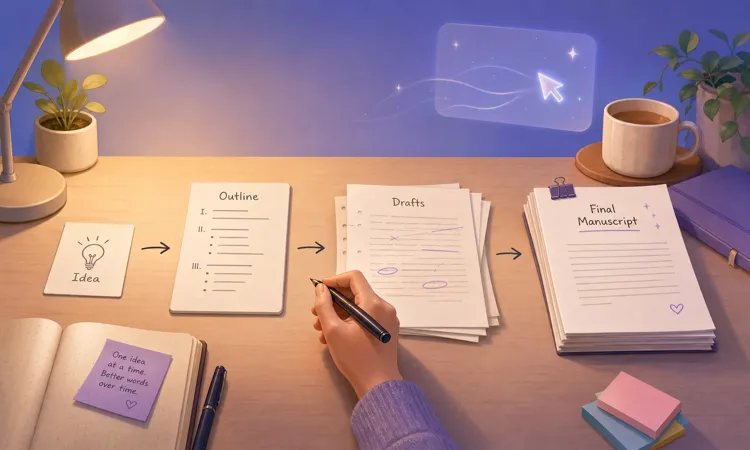
You have the prompt. Good. The hard part is not finding the idea. It is turning that idea into something that holds together once you start writing. Here are two workable paths. If you are after unique creative writing prompts, this is also where you start to make them feel like yours.
The Traditional Way: From Prompt to Outline to Draft
This is the slower path, and it works if you can tolerate not knowing everything up front.
Step 1: Interrogate the prompt. Don't start writing immediately. Instead, ask questions. Take prompt #63: "A woman is ghostwriting his memoir. The more she learns about his past, the more she realizes she was part of it." Who is she? Who is he? How were their lives connected? What doesn't he know? What doesn't she know? Spend 15 minutes with a notebook and just ask questions. Don't answer them all. Let some stay open.
Step 2: Find the three turns. Every story needs at least three pivots — moments where the direction changes. The Purdue OWL fiction writing basics guide is useful for plot, character, and point of view. For this prompt, the turns might be: (1) She takes the ghostwriting job, (2) She discovers the connection, (3) She decides whether to tell him. That's your skeleton. Everything else is muscle and skin.
Step 3: Write the first scene. Not the opening line. Not the perfect paragraph. Just the first scene — a character in a place, wanting something, running into resistance. You can rearrange later. For now, get something on the page that breathes.
Step 4: Follow the draft. Outlines are guides, not contracts. The best moments in a story often come from following a character's logic when it deviates from your plan. Let it deviate. Fix the structure in revision.
For most writers, this process is slower than AI-assisted brainstorming, but it builds craft skills that compound over time.
The AI-Assisted Way: From Prompt to Story in Minutes
AI does not replace the creative process. It shortens the part where you are still trying to find the shape of the story. That can help when you already know you want to write and just need momentum.
Step 1: Expand the prompt into a premise. Take the same prompt (#63) and ask an AI assistant: "Help me develop this into a one-paragraph story premise. Who is the ghostwriter? Who is the subject? What was their connection?"
The AI might suggest: "Elena, a 34-year-old ghostwriter specializing in political memoirs, is hired by Julian Voss, a retired diplomat. As she transcribes his stories of a summer spent in Buenos Aires in the 1990s, she realizes the woman he keeps describing — 'the translator's daughter' — is her mother. Her mother never mentioned knowing him. And Julian doesn't seem to recognize Elena's surname."
You didn't write that premise from scratch — but you chose it. You shaped the follow-up questions. The creative control remains yours.
Step 2: Build the world and characters. With the premise in hand, you can drill deeper: "What is Elena's relationship with her mother like now? What is Julian hiding about that summer? What would happen if Elena reveals who she is?" AI brainstorming gives you ten options where your notebook might give you two. You still pick the best one.
Step 3: Draft chapter by chapter. Instead of staring at a blank page for Chapter 1, you can ask the AI to draft an opening scene based on your premise and characters. Read it. Keep what works. Rewrite what doesn't. Then move to the next scene. This chained approach keeps momentum high and the blank-page problem near zero.
Step 4: Edit and refine in your own voice. AI-generated prose is a starting point, not a final product. The revision is where your voice, your word choices, your rhythm come in. This is the step that separates a draft from a story.
Real Example: One Prompt, Two Approaches
Take prompt #69: "After a mix-up at the post office, two strangers start exchanging letters meant for someone else. They keep writing anyway."
The traditional approach:
You'd start by deciding who these two people are. Maybe she's a woman in a small town writing to her sister abroad. Maybe he's a man in the city writing to a lawyer about an inheritance. The letters get swapped. Each reads something intimate about the other's life. They write back — not to correct the mistake, but because they recognize something in the other person's words.
You'd draft the first letter, then the response, building the relationship through voice alone. You'd figure out the turning point: maybe she Googles the return address. Maybe he shows up at the post office and they meet. Maybe they deliberately avoid meeting because the letters are better than reality could be.
This would take you perhaps a week of writing sessions — 3,000-5,000 words of careful epistolary fiction.
The AI-assisted approach:
You could paste the prompt into an AI story development tool such as SeaBell and ask for a premise, character profiles, and several possible outlines. The AI might suggest an epistolary structure, a dual-POV narrative, or a timeline that jumps between the letters and the characters' real lives.
You'd select the structure you like, then use SeaBell's chapter-by-chapter drafting to produce a first draft. You'd revise each chapter in your own voice, cutting the AI's generic phrasing and adding your specific details — the coffee stain on the letter, the way her handwriting changes when she's nervous.
Total time: often much shorter than building every option from scratch, especially if you already know the kind of story you want to write. Same creative decisions, same final ownership — compressed process.
Neither path is better. They just serve different writers at different moments. The point is simple: a prompt is only the first move. The process after that matters more than the spark.
Ready to try? Take any prompt from this page and see whether SeaBell's AI-assisted novel drafting tools can help you turn it into a usable story outline.
❓ Frequently Asked Questions About Creative Writing Prompts
What are creative writing prompts?
A creative writing prompt is a short idea, scenario, or question designed to give you a starting point for a piece of fiction (or sometimes nonfiction). Prompts can be as simple as a single sentence ("Write about a door that shouldn't be open") or as structured as a full scenario with characters, settings, and constraints. Their purpose is to eliminate the blank-page problem and give your imagination a specific direction to run in.
How do beginners start with creative writing prompts?
Start with short, low-pressure prompts — one-liners or story starters that you can respond to in 10-15 minutes. Don't worry about writing a complete story. Focus on writing a single scene: one character, one moment, one problem. As you build confidence, move to longer prompts with more complex scenarios. The "Story Starters" and "Flash Fiction" sections on this page are designed specifically for beginners.
Can I use AI with creative writing prompts?
Yes. AI writing tools can help you expand a prompt into a full premise, brainstorm characters and plot points, and draft scenes chapter by chapter. The key is to use AI as a brainstorming partner and first-draft accelerator, not as a replacement for your creative judgment. You still choose the direction, make the creative decisions, and revise in your own voice. SeaBell's AI novel generator is built for this workflow.
What's the best genre to start with for new writers?
Contemporary fiction or contemporary romance tends to be the most accessible starting point — the world is familiar (no worldbuilding required), and the emotional stakes are immediately relatable. That said, if you're drawn to fantasy or horror, start there. Writing in a genre you love will keep you motivated longer than writing in a genre someone told you was "easier."
How do I turn a writing prompt into a full novel?
Start by expanding the prompt into a one-paragraph premise: Who is the main character? What do they want? What stands in their way? Then build outward — develop the key supporting characters, identify 3-5 major plot turns, and write a rough chapter outline. Don't try to plan the whole book before writing. Draft the first three chapters, then reassess your outline based on what the characters are doing. Many novelists find that the story changes significantly once the characters start "making decisions" on the page.
What makes a good creative writing prompt?
A good creative writing prompt creates pressure. It gives the writer a situation, a character, or a question that cannot stay still. The best prompts usually include conflict, uncertainty, or a small contradiction: a letter from the future, a locked room with one impossible clue, or two people who need each other but cannot trust each other.
Can teachers use these creative writing prompts in class?
Yes. Many of these prompts work for classroom writing exercises, especially the beginner-friendly story starters, character prompts, dialogue prompts, and flash fiction ideas. For high school students, start with short prompts that can be completed in 10-15 minutes, then ask students to revise one scene for voice, conflict, or sensory detail.
How often should I use writing prompts?
Use writing prompts as often as they help you write, not as a way to avoid larger projects. Daily writing prompts can build consistency, but you should occasionally return to one idea and develop it into a complete scene, short story, or chapter. The goal is not to collect prompts. The goal is to finish writing.
Are writing prompts copyrighted?
Generally, no. A short prompt — a sentence or two describing a scenario — is usually too brief and too general to qualify for copyright protection. What is protected is the specific story you write from that prompt. U.S. copyright law also draws a line between expression and underlying ideas: 17 U.S.C. 102(b) on ideas and copyright protection says copyright protection does not extend to an idea, procedure, process, system, method of operation, concept, principle, or discovery. So you can use any prompt on this page as a starting point. The idea itself is not protected.
✅ Start Writing
You now have 210 prompts organized by genre, skill level, and craft focus. You also have a couple of ways to work with them. The only thing left is to choose one and start.
Pick a prompt. Set a timer for 15 minutes. Do not outline the whole thing. Just write the first version.
If you want a faster path from prompt to draft, explore SeaBell's AI novel writing tools. They are built for that kind of work.
The blank page is usually less empty than it looks. It just needs a first sentence.