
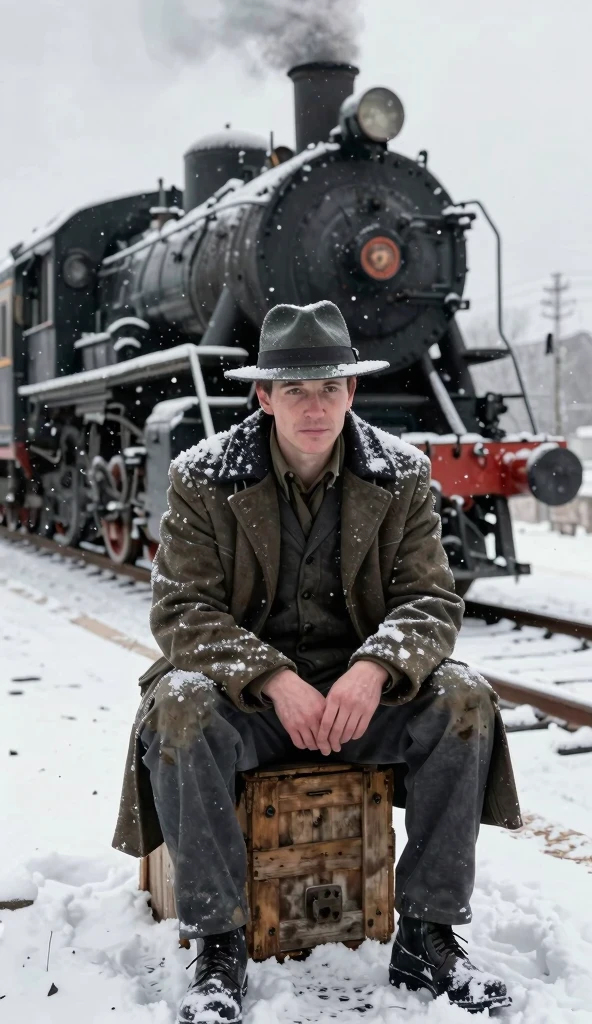
Winter Train Crime Of Me
Zusammenfassung
Murders committed on a train one winter day and the events that befall the detective trying to solve them.
Kapitel1
The train carved a jagged line through the white silence of the mountain pass. Outside, the landscape was a smear of grey and bone-white, a world erased by the blizzard. Inside the carriage, the air was heavy with the smell of wet wool, coal dust, and the stale, lingering scent of tea. Elias Thorne sat in the corner of the fourth coach, his coat bunched around his shoulders, his eyes fixed on the reflection of the cabin in the dark window. He didn't look like a man who had once held the keys to the city’s most dangerous secrets. He looked like a man waiting for a bus that would never arrive.
He tapped a cigarette against his thumbnail, though he didn't light it. His hands were steady, a cruel joke played by his nervous system, which had long since abandoned the capacity for panic. He had lost the badge, the pension, and the house with the peeling white paint that Sarah had loved. What remained was a hollowed-out husk of a man, a detective who had forgotten how to be anything else.
The train jolted, a sudden, violent shudder that rattled the luggage racks. A woman in a charcoal-grey suit three rows ahead gripped the armrest until her knuckles turned white. It was a reaction too sharp, too deliberate. Elias watched her. He had been watching the occupants of this carriage for three hours, not out of duty, but out of a desperate, gnawing need to keep his mind occupied. She wasn't a traveler. She was a sentry.
Then, the first disappearance happened.
It began with a man in the dining car. He had been there when Elias went for a bitter cup of coffee, nursing a whiskey and a book. When Elias returned twenty minutes later, the seat was empty. The man’s hat remained on the hook, a soft felt fedora, but the man was gone. Elias had asked the steward, a man with a face like a crumpled napkin. The steward had shrugged. "Maybe he went to the lavatory, sir. Or back to his cabin."
But the man didn't come back. An hour later, the train conductor walked the aisle, his face pale, his uniform jacket buttoned wrong. He didn't ask for tickets. He was looking for someone.
Elias stood up. The rhythm of the train—the rhythmic *clack-clack, clack-clack*—was the only constant. He walked toward the conductor. "Who are you missing?"
The conductor jumped, his eyes darting to the woman in the charcoal suit, then back to Elias. "No one, sir. Just checking the ventilation."
"You're shaking," Elias said, his voice low, gravelly from years of shouting at suspects and swallowing cheap bourbon. "And you're lying. You're looking for someone who isn't there anymore."
The woman in the charcoal suit stood up. She walked past them, her stride precise, her gaze fixed on the floor. As she passed, she leaned toward the conductor and whispered something. It was a sound like dry leaves skittering on pavement. The conductor’s face went from pale to grey.
Elias followed them. He wasn't a detective anymore, not officially, but the instinct was a parasite. It lived in his marrow. He watched as they ducked into the vestibule between cars. He waited, his breath hitching in the freezing draft that leaked through the door seals.
"He's asking questions," the woman said. Her voice was sharp, accented, cold. "The old man in the corner. He's not a passenger. He knows the look."
"He's nobody," the conductor replied, his voice trembling. "Just a drunk."
"He's a cop," the woman hissed. "Or he was. Get rid of him. Not now—later. When the snow stops."
Elias turned, his heart hammering against his ribs. He felt a sudden, electric jolt of adrenaline. It was the first time in months he had felt alive. It was a dangerous, jagged feeling, but it was real. He retreated to his seat, his mind racing. He wasn't just on a train; he was in a cage with two starving wolves, and he was the piece of meat they were currently ignoring.
He began to move through the train, not with stealth, but with the brazen confidence of a man who had nothing left to lose. He questioned the passengers. He asked about the man in the fedora. He looked into their eyes—the businessman with the briefcase chained to his wrist, the young couple whispering in the back, the elderly man with the cane. He saw the shift in their posture, the way they hid their hands, the way they avoided his gaze. He wasn't looking for a killer; he was looking for the crack in the veneer.
By the time the train ground to a screeching halt, the panic had begun to percolate. People were whispering. Someone had found a bloodstain on the floor of the lavatory in the second carriage. The news spread like ink in water.
The train sat in the middle of a frozen wasteland, the snow piling up against the wheels. The conductor announced over the intercom, his voice cracking, that they were waiting for the authorities to clear the tracks ahead. No one was to leave their seats.
Elias stood in the aisle. He looked at the passengers. They were staring at him. Not with fear of the killer, but with suspicion of *him*. The woman in the charcoal suit had moved to the opposite end of the aisle. She was talking to a man in a blue overcoat—the man who had been sitting three rows behind her the whole time. They were watching Elias. They were whispering.
"He's the one," the woman said, her voice carrying just enough to be heard by the surrounding passengers. "I saw him near the lavatory. He was carrying a knife."
The lie was so simple, so effective. Elias felt the air in the carriage shift. The passengers pulled back, forming a circle of empty space around him. The businessman with the briefcase gripped it tighter. The young couple stood up and moved to the other end of the car.
Elias walked toward the woman in the charcoal suit. "You're good," he said, his voice calm. "But you're sloppy. There's no knife."
"Stay back," she said, her hand reaching into her pocket.
"Are you going to shoot me here?" Elias asked, a mirthless smile touching his lips. "In front of everyone? That would be a bold move for a ghost."
The man in the blue overcoat stepped between them. He was tall, his shoulders broad, his eyes dead. "We don't know who you are, sir. But you're upsetting the passengers. Sit down."
"I know who you are," Elias said, looking the man in the eye. "You're the reason the man in the fedora is gone. You're the reason the conductor is terrified. You're not agents. You're just butchers."
The train car went silent. The only sound was the wind howling against the frozen metal of the exterior. The passengers were terrified, but not of the agents. They were terrified of the chaos. And in the center of that chaos, Elias Thorne was the only focal point.
The murders continued.
It happened in the dark. The train’s power flickered, the lights died, and for ten minutes, the carriage was plunged into a suffocating blackness. When the lights buzzed back to life, the elderly man with the cane was gone. In his place, on the seat, was a single, bloody glove.
The scream came from the woman in the charcoal suit. She stood up, pointing a trembling finger at Elias. "He did it! He was sitting right there! He moved in the dark!"
Elias looked at his hands. They were clean. He looked at the empty seat. He felt the weight of the collective gaze of the carriage. They didn't care about the truth. They wanted a narrative. They wanted a villain they could understand, someone they could point to so they could feel safe again. And the agents were providing it to them, perfectly packaged.
Elias stood up. He felt the cold iron of the train’s wall against his back. He was trapped. He looked at the man in the blue overcoat. The man was watching him with a look of bored indifference. He had already decided Elias’s fate.
Elias realized then that he couldn't fight them with fists. He couldn't fight them with logic. He had to play their game. He had to be the detective one last time. He began to move, not toward his seat, but toward the baggage compartment. He noticed the man in the blue overcoat twitch—a micro-movement of muscle in his jaw. *That’s it,* Elias thought. *That’s the anchor.*
He started to search the luggage. He wasn't looking for a weapon. He was looking for the mundane. He found a suitcase belonging to the woman in the charcoal suit. It was locked, but the lock was cheap. He forced it. Inside, there were no clothes. There were documents, maps, and a small, black device with a glowing red light.
He held it up. The carriage watched. The woman lunged at him.
Elias stepped aside, his movements fluid, the instinct of a hunter surfacing. He grabbed her wrist, twisting it until she cried out. The man in the blue overcoat drew a silenced pistol from beneath his coat.
"Drop it," the man said.
Elias didn't drop it. He held it up for everyone to see. "Do you see this? This is why they're killing people. This isn't a murder mystery. It's a war. And you're just collateral damage."
The passengers stared at the device. They didn't know what it was, but they knew it didn't belong on a train. The man in the blue overcoat hesitated. He couldn't shoot. Not now. Not with everyone watching.
"They're waiting for the authorities," Elias realized aloud, his voice echoing in the confined space. "They aren't killing because they want to. They're killing because they have to keep the train moving. They're waiting for the authorities to arrive so they can hand over their 'suspect' and vanish in the confusion."
The realization hit him like a physical blow. He wasn't the detective solving a mystery. He was the scapegoat being groomed for the slaughterhouse. The agents weren't trying to hide the murders; they were choreographing them.
The train whistle shrieked. Through the window, Elias saw the lights of a station cutting through the blizzard. The authorities were coming.
The panic in the carriage shifted again, from fear of the killer to a desperate, clawing need to escape. The doors opened. The cold air rushed in. The station platform was lined with police officers, their weapons drawn.
Elias was the first one off the train. He stumbled onto the icy platform, his lungs burning with the sharp, frozen air. He raised his hands, the device still in his grip.
"Help!" he shouted, his voice cracking. "They're on the train! They're agents! They killed them!"
The police surrounded him instantly. They didn't look at the train. They didn't look at the passengers. They looked at Elias. They saw a disheveled man, holding a strange device, shouting accusations. They saw the man the woman in the charcoal suit had pointed out earlier.
"Drop the weapon!" an officer shouted.
"It's not a weapon!" Elias screamed, his voice raw. "Look at the train! The woman in the grey suit! The man in the blue coat! They're the ones!"
The man in the blue overcoat stepped off the train. He walked toward the police officer, his face a mask of calm, professional concern. "Officer," he said, his voice smooth, authoritative. "I'm sorry we caused such a scene. This man… he’s been terrorizing us since we left the city. He’s unstable. He killed two people. We tried to stop him, but he held us at bay."
Elias stared at the man. He saw the cold, calculated truth in his eyes. It was a perfect story. A deranged man, a tragic accident, a swift resolution.
"No," Elias whispered. "No."
The police officers tackled him to the ground. The snow was cold against his face, a numbing, indifferent embrace. He felt the handcuffs snap shut around his wrists. He saw the woman in the charcoal suit standing by the train, her face etched with a look of practiced sorrow.
"Take him away," the officer said.
Elias was dragged toward a waiting car. He looked back at the train, at the people who had been his fellow passengers. They were huddled together, whispering, pointing at him. They were already rewriting the story. They were already turning him into the monster they needed him to be.
He didn't fight. The fight had left him. He looked up at the grey, swirling sky, at the flakes of snow that fell, one by one, indifferent to the lives they covered. He thought of Sarah. He thought of the house with the peeling paint. He thought of the badge he had once worn with pride.
He was shoved into the back of the police car. The door slammed shut, sealing him in. The man in the blue overcoat watched from the platform, his expression unreadable. He turned and walked away, disappearing into the crowd, a ghost returning to the shadows.
The next morning, the newspaper was folded on the table of a local diner. The headline was small, buried in the back pages.
*DERANGED MAN CONFESSES TO TRAIN MURDERS; COMMITS SUICIDE IN CUSTODY.*
The report was brief. It mentioned the detective, his history of instability, the mounting evidence found in his possession, and the tragic, inevitable end of a man who had finally run out of road. It didn't mention the agents. It didn't mention the device. It didn't mention the truth.
The snow continued to fall, burying the tracks, the station, and the memory of the man who had tried to find the truth in a world that preferred a lie. The train moved on, its rhythm steady, its passengers safe, the story firmly closed.
Das könnte Ihnen auch gefallen
Keine Empfehlungen
Derzeit keine Empfehlungen – schauen Sie später wieder vorbei!